Overview
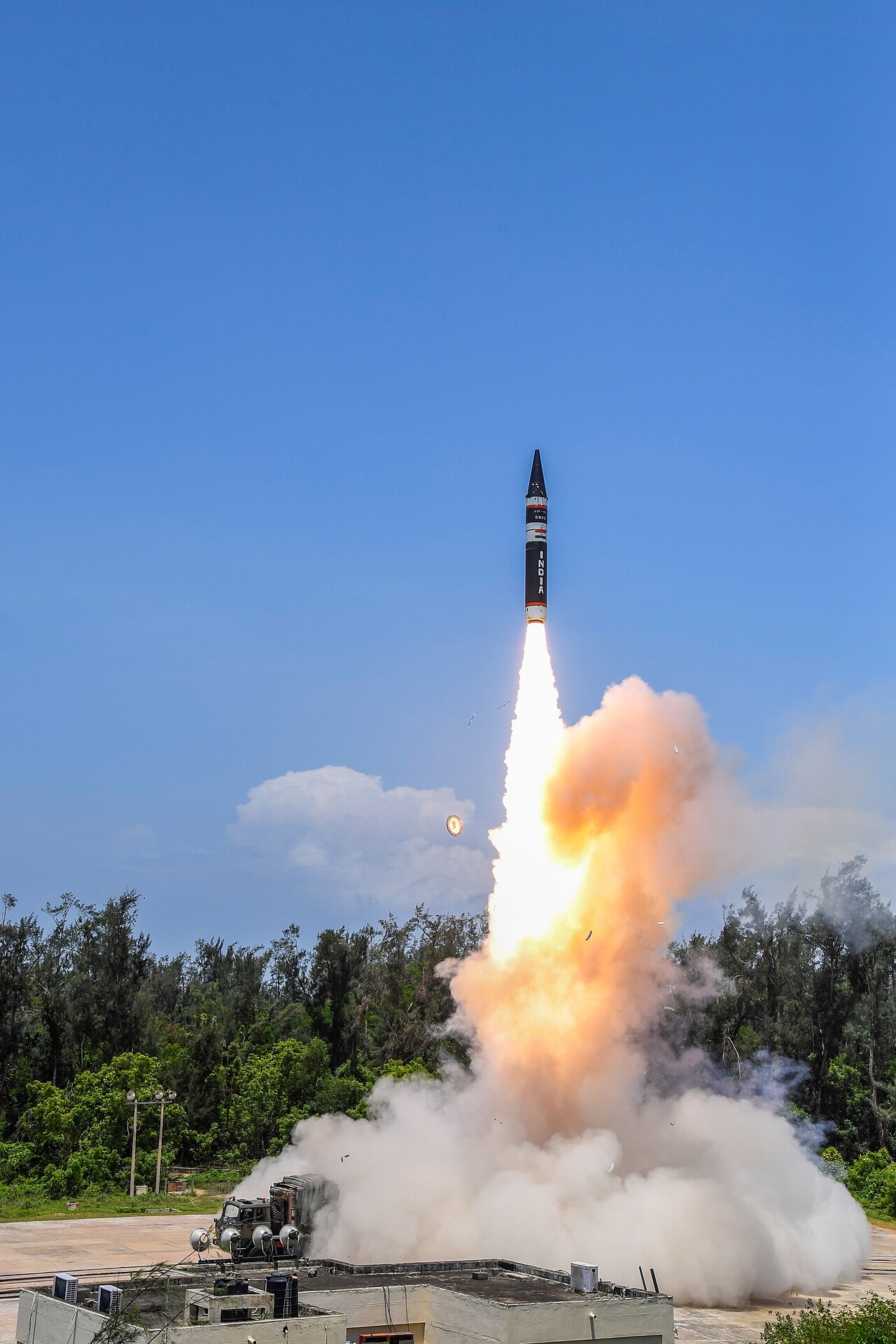
Agni-P (Agni-Prime) is an indigenously developed intermediate-range ballistic missile (IRBM) designed by India’s Defence Research and Development Organisation (DRDO) as a next-generation successor to the Agni series. It represents a significant technological leap by combining advanced propulsion, navigation, and guidance systems to enhance the missile’s range, accuracy, and survivability. Agni-P is strategically positioned to fill the gap between short-range ballistic missiles and longer-range intermediate ballistic missiles, with a range capability of approximately 1,000 to 2,000 kilometers.
This missile is designed with modern warfare requirements in mind—it is lighter, more compact, and road-mobile, allowing for rapid deployment and greater operational flexibility. The mobility factor greatly enhances its survivability, ensuring a credible second-strike capability in the event of conflict escalation. Agni-P incorporates state-of-the-art composite materials and advanced solid-fuel propulsion, making it quicker to deploy and easier to maintain compared to earlier Agni variants.
The missile also integrates sophisticated navigation and guidance systems, including an advanced ring laser gyro-based inertial navigation system (RINS) coupled with satellite navigation (INS/GPS) for improved accuracy. It is capable of delivering multiple warhead configurations, including conventional, nuclear, and possibly MIRV (Multiple Independently Targetable Reentry Vehicle) payloads, which enhance its strategic deterrence value. Agni-P exemplifies India’s commitment to self-reliance under the Make in India initiative, showcasing indigenous design and manufacturing capabilities in missile technology.
Specifications
| Parameter | Specification |
|---|---|
| Missile Name | Agni-P (Agni-Prime) |
| Type | Intermediate-Range Ballistic Missile (IRBM) |
| Length | ~12 meters (estimated) |
| Diameter | ~1 meter (estimated) |
| Launch Weight | ~16,000 - 17,000 kg (estimated) |
| Propulsion | Two-stage solid-fuel rocket motor |
| Range | 1,000 – 2,000 km |
| Payload Capacity | ~1,000 – 1,500 kg |
| Warhead Types | Conventional, Nuclear, Multiple warheads (MIRV capable) |
| Guidance System | Ring Laser Gyroscope Inertial Navigation System (RINS) + Satellite Navigation (INS/GPS) |
| Accuracy (CEP) | <10 meters (classified, estimated) |
| Launch Platform | Road-mobile Transporter Erector Launcher (TEL) |
| Reaction Time | Quick reaction, rapid launch readiness |
| Deployment Status | Under induction/testing phase (as of 2026) |
| Manufacturer | Defence Research and Development Organisation (DRDO) / Bharat Dynamics Limited (BDL) |
| Operational Range Zone | South Asia and parts of Southeast Asia |
Key Features
🚀 Enhanced Mobility and Survivability
- Road-mobile TEL launcher enables rapid deployment and survivability against pre-emptive strikes.
- Compact and lighter design compared to Agni-IV and Agni-V, improving operational flexibility.
🎯 Advanced Navigation and Accuracy
- Incorporates state-of-the-art ring laser gyroscope-based inertial navigation combined with satellite guidance for high-precision targeting.
- Estimated Circular Error Probable (CEP) under 10 meters, significantly improving strike effectiveness.
🛡️ Strategic Payload Flexibility
- Capable of delivering conventional or nuclear warheads, including multiple warhead configurations such as MIRVs.
- Payload capacity up to 1,500 kg allows for varied warhead types and countermeasures.
⚡ Quick Reaction Capability
- Solid-fuel propulsion enables shorter launch preparation time compared to liquid-fueled missiles.
- Designed for rapid deployment and launch, suitable for dynamic battlefield scenarios.
🛠️ Indigenous Design and Manufacturing
- Developed under the Make in India initiative, ensuring self-reliance in strategic missile technology.
- Utilizes advanced composite materials and modern manufacturing techniques for enhanced missile performance.
Variants
As of 2026, Agni-P itself is a new variant in the Agni missile family, intended to replace and complement earlier models such as Agni-I, Agni-II, Agni-III, and Agni-IV. Future sub-variants or improved blocks may emerge as testing progresses, potentially including:
- Agni-P Block I: Baseline version with standard range and payload.
- Agni-P Block II: Potential future upgrade with extended range and MIRV capability.
- Agni-P Tactical Variant: Speculated development for shorter range with enhanced accuracy for battlefield use (unconfirmed).
Operational Status
Agni-P underwent its maiden test flight on June 18, 2021, successfully validating its design parameters. Subsequent tests have demonstrated improved range, mobility, and accuracy. As of early 2026, the missile is in advanced stages of induction with the Strategic Forces Command (SFC), gradually replacing aging Agni-I and Agni-II systems to provide the Indian Armed Forces with a more versatile and survivable IRBM option.
Deployment on road-mobile Transporter Erector Launchers (TELs) has been optimized for quick strategic mobility, allowing the missile to be dispersed across various locations, enhancing deterrence and complicating enemy targeting efforts. The missile system is expected to be fully operational in the coming years, forming a critical component of India’s nuclear triad and strategic deterrence posture.
Development Timeline
| Date | Milestone |
|---|---|
| 2015 | Project conceptualization and initial design begins. |
| 2019 | Design and development phase initiated by DRDO. |
| June 18, 2021 | Maiden successful test flight conducted from APJ Abdul Kalam Island, Odisha. |
| 2022 – 2023 | Subsequent validation and range extension tests. |
| 2024 | Integration of advanced guidance systems and payload verification tests. |
| 2025 | Induction into Strategic Forces Command begins. |
| 2026 (expected) | Full operational capability and deployment across multiple units. |
Strategic Significance
Agni-P is a cornerstone in India’s strategic deterrence architecture. Its intermediate range of 1,000 to 2,000 km effectively bridges the gap between short-range tactical ballistic missiles and longer-range strategic assets like Agni-IV and Agni-V. This capability ensures India can target a wide spectrum of strategic targets across South Asia and beyond with high precision.
The missile’s road mobility enhances survivability, making it difficult for adversaries to detect and preemptively neutralize India’s nuclear capabilities. This mobility ensures a credible second-strike capability, a critical factor in maintaining strategic stability in the region.
Agni-P’s development also represents a leap forward in indigenous missile technology, reducing reliance on foreign suppliers and reinforcing the Make in India initiative. Its advanced guidance and propulsion systems elevate India’s missile technology to near cutting-edge levels, ensuring deterrence credibility against evolving threats.
Future Upgrades
Looking ahead, potential upgrades to Agni-P may include:
- MIRV Capability: Development and integration of Multiple Independently Targetable Reentry Vehicles to enable multiple warheads on a single missile, increasing strike options and survivability.
- Enhanced Range: Extending the missile’s range beyond 2,000 km to cover a broader strategic footprint.
- Improved Guidance Systems: Integration of newer satellite navigation constellations such as Indian Regional Navigation Satellite System (IRNSS/NavIC) for enhanced redundancy and accuracy.
- Countermeasures: Incorporation of advanced electronic countermeasures and stealth features to evade missile defense systems.
- Integration with Nuclear Command: Enhanced secure communication links and launch protocols for rapid response.
Comparison Table
| Feature | Agni-P | Agni-IV | Agni-V |
|---|---|---|---|
| Range | 1,000 – 2,000 km | 2,000 – 3,500 km | 5,000+ km |
| Payload Capacity | ~1,000 – 1,500 kg | ~1,000 kg | ~1,500 kg |
| Mobility | Road-mobile TEL | Road-mobile TEL | Road-mobile TEL/rail-mobile |
| Guidance System | RINS + Satellite Navigation | Inertial + Satellite | Inertial + Satellite |
| Warhead Types | Conventional, Nuclear, MIRV (planned) | Conventional, Nuclear | Nuclear |
| Launch Preparation Time | Quick (solid-fueled) | Moderate | Moderate |
| Accuracy (CEP) | <10 m (estimated) | ~10 m | <10 m |
| Deployment Status | Under induction | Operational | Operational |
Key Takeaways
- ✅ Agni-P bridges the strategic capability gap with 1,000-2,000 km range IRBM class missile.
- 🎯 Incorporates advanced navigation systems ensuring high accuracy and precision strikes.
- 💪 Road-mobile launcher enhances missile survivability and quick deployment.
- 🛡️ Capable of carrying multiple warhead types, including nuclear and potential MIRVs.
- 🇮🇳 Fully indigenous design under DRDO, boosting India’s self-reliance in missile technology.
- ⚡ Solid-fuel propulsion allows for rapid launch readiness and minimal maintenance.
- 🔒 Strengthens India’s credible minimum deterrent and second-strike capabilities.
Last updated: February 2026
Status: Under induction and limited operational deployment
Deployed with: Strategic Forces Command (SFC), Indian Army Strategic Missile Force
Sources & References:
- Defence Research and Development Organisation (DRDO) official releases
- Press Information Bureau (PIB), Government of India
- Jane’s Defence Weekly, Missile Systems Report 2021-2026
- The Hindu, Times of India defense coverage
- Indian Strategic Studies publications