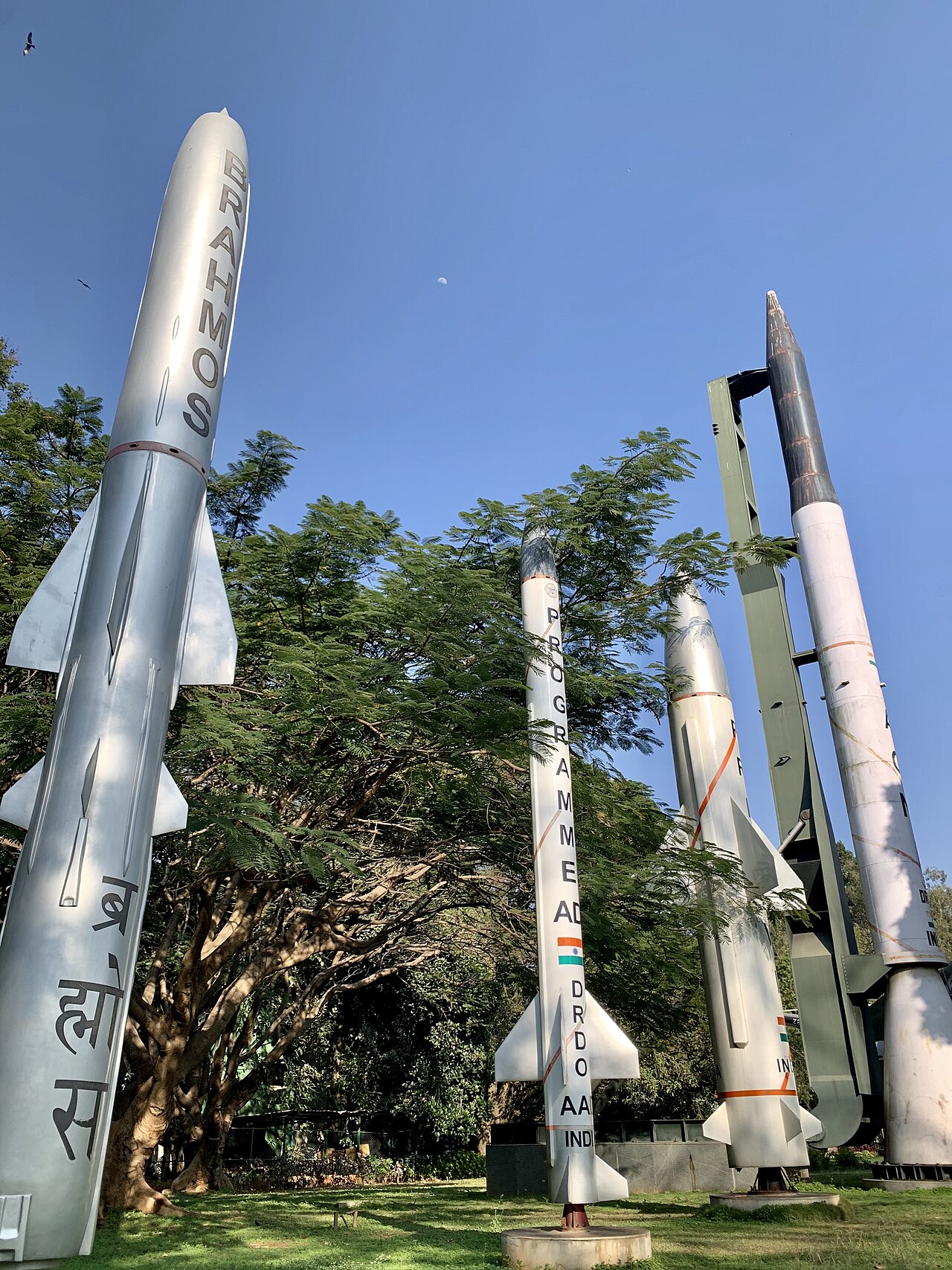
Overview
BrahMos (named after Brahmaputra and Moskva rivers) is a supersonic cruise missile developed as a joint venture between India’s DRDO and Russia’s NPO Mashinostroyeniya. It is the fastest operational cruise missile in the world.
Specifications
| Specification | Details |
|---|---|
| Type | Supersonic Cruise Missile |
| Origin | India-Russia |
| Manufacturer | BrahMos Aerospace |
| Speed | Mach 2.8-3.0 (3,450-3,675 km/h) |
| Range | 290-500 km |
| Warhead | 200-300 kg conventional |
| Guidance | Inertial + GPS + Active Radar |
| Launch Platforms | Land, Sea, Air, Submarine |
Key Features
🚀 Speed Advantage
- Supersonic speed (nearly 3 times speed of sound)
- Reduces reaction time for enemy air defense
- High kinetic energy impact
🎯 Precision Strike
- Multi-platform launch capability
- Fire-and-forget capability
- Low-altitude cruise for terrain hugging
- Steep dive attack profile
🛡️ Variants
1. Land-Based (Block-I/II/III)
- Mobile autonomous launchers
- Road-mobile TEL (Transporter Erector Launcher)
- Range: 290-400 km
2. Ship-Based (Naval)
- Vertical Launch System (VLS)
- Fitted on destroyers, frigates, corvettes
- All-weather capability
3. Air-Launched (BrahMos-A)
- Launched from Su-30MKI fighters
- Extended range variant
- Stand-off strike capability
4. Submarine-Launched (BrahMos-NG)
- Next generation variant
- Smaller, lighter version
- Under development
Operational Status
Indian Armed Forces
- Army: Regiment equipped with mobile launchers
- Navy: Deployed on 15+ warships
- Air Force: Su-30MKI squadrons equipped
Export Potential
- Philippines: First export customer (2022)
- Several nations expressing interest
- Strategic partnership opportunities
Strategic Significance
Regional Deterrence
- Asymmetric advantage in Indo-Pacific
- Credible strike capability
- Anti-ship warfare dominance
Make in India Success
- Indigenous content increasing
- Technology absorption
- Export revenue potential
Operational Flexibility
- Multi-domain strike capability
- Rapid response system
- Network-centric warfare ready
Development Timeline
- 1998: Joint venture formed
- 2001: First test flight
- 2005: Indian Army induction
- 2006: Indian Navy induction
- 2019: Air-launched version operational
- 2022: First export to Philippines
- 2024: Extended range variant tested
Future Upgrades
BrahMos-II (Hypersonic)
- Speed: Mach 7-8
- Under development
- Timeline: 2028-2030
BrahMos-NG (Next Generation)
- 50% lighter and smaller
- Enhanced maneuverability
- Submarine compatibility
BrahMos-ER (Extended Range)
- Range: 800+ km
- Testing phase
- MTCR compliance path
Combat Advantages
✅ Nearly impossible to intercept due to speed ✅ Pinpoint accuracy with multi-mode guidance ✅ Versatile deployment from all domains ✅ Weather independent operations ✅ Low radar signature during cruise phase
Comparison with Competitors
| Missile | Speed | Range | Origin |
|---|---|---|---|
| BrahMos | Mach 2.8-3.0 | 290-500 km | India-Russia |
| Tomahawk | Mach 0.74 | 1,600+ km | USA |
| YJ-18 | Mach 3.0 | 540 km | China |
| P-800 Oniks | Mach 2.5 | 600 km | Russia |
Key Takeaways
- 🥇 World’s fastest operational cruise missile
- 🇮🇳 Indigenous technology with Russian partnership
- 🎯 Multi-platform land, sea, air launch capability
- 🚀 Strategic deterrent in Indo-Pacific region
- 💪 Export success - first customer Philippines
- 🔮 Future variants - hypersonic BrahMos-II in development
Last Updated: February 2026 Status: Operational Deployed: Indian Army, Navy, Air Force Export: Philippines (2022)
BrahMos represents India’s growing prowess in missile technology and strategic deterrence capabilities.