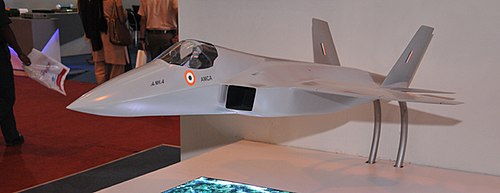
Overview
The HAL Advanced Medium Combat Aircraft (AMCA) represents a major leap forward in India’s aerospace and defense capabilities. Developed by Hindustan Aeronautics Limited (HAL), the AMCA is set to be India’s first indigenous fifth-generation multi-role stealth fighter aircraft. Designed to compete with leading global stealth fighters, the AMCA aims to provide the Indian Air Force (IAF) with superior air dominance, precision strike, and survivability in complex operational environments.
The AMCA incorporates cutting-edge stealth technologies, including internal weapons bays, radar-absorbent materials (RAM), and an optimized airframe to minimize radar cross-section (RCS). It is designed to feature a supercruise capability, allowing it to sustain supersonic speeds without afterburners, thereby enhancing fuel efficiency and reducing infrared signature. With advanced sensors such as an Active Electronically Scanned Array (AESA) radar and sensor fusion systems, the AMCA will provide pilots with unparalleled situational awareness and targeting precision.
In addition to its stealth and avionics advances, the AMCA program embodies India’s strategic goal of self-reliance in critical defense technologies. Both single-engine and twin-engine variants are planned, with the twin-engine version expected to offer enhanced thrust and payload capabilities. The aircraft is poised to become the backbone of the IAF’s future fighter fleet, securing India’s airspace against emerging threats.
Specifications
| Parameter | Details |
|---|---|
| Manufacturer | Hindustan Aeronautics Limited (HAL) |
| Role | Fifth-Generation Multi-role Stealth Fighter |
| Crew | 1 (Single-seat) |
| Length | Approx. 15.5 meters (estimated) |
| Wingspan | Approx. 11 meters (estimated) |
| Height | Approx. 4.5 meters (estimated) |
| Maximum Takeoff Weight | ~25,000 kg (estimated) |
| Powerplant | Single or twin-engine variants planned; likely based on GE F414 or indigenous Kaveri-derived engines |
| Maximum Speed | Mach 2+ (supercruise capability expected) |
| Combat Radius | Approx. 800-1,000 km (estimated) |
| Service Ceiling | 16,000+ meters (estimated) |
| Armament | Internal weapon bays for air-to-air and air-to-ground missiles; external hardpoints (limited use for stealth missions) |
| Avionics | AESA Radar, advanced electronic warfare suites, sensor fusion, helmet-mounted displays |
| Stealth Features | Internal weapons bays, RAM coatings, angular stealth design |
| First Flight (Planned) | Targeted for 2026-2027 |
| Operational Introduction | Mid-2030s (planned) |
Note: Due to the classified nature of the project, many specifications are approximate based on available open-source intelligence and official statements.
Key Features
🚀 Stealth and Low Observability
- Designed with stealth-optimized airframe geometry to reduce radar cross-section (RCS)
- Internal weapons bays to maintain clean external profile during combat
- Use of radar-absorbent materials (RAM) and coatings
- Reduced infrared and electronic signatures
🎯 Advanced Avionics and Sensor Fusion
- Equipped with indigenous AESA radar for multi-target tracking and long-range engagement
- Sensor fusion integrating radar, electronic warfare, IRST (Infrared Search and Track), and communication systems to enhance situational awareness
- Helmet-mounted display system (HMDS) for pilot situational awareness and targeting
💪 Supercruise Capability
- Designed to sustain supersonic flight without afterburners, improving range and survivability
- Enhanced engine performance with plans for indigenous Kaveri engine integration in future variants
🛡️ Multi-role Combat Capability
- Capable of air superiority, ground attack, precision strike, and electronic warfare missions
- Flexible payload options with smart weapons and stand-off missiles
- Advanced electronic warfare and self-protection suites for survivability in contested environments
Variants
| Variant | Description |
|---|---|
| AMCA Mark 1 (Single Engine) | Initial production variant likely powered by a single GE F414 engine or an indigenous equivalent; optimized for air superiority and multi-role missions |
| AMCA Mark 2 (Twin Engine) | Planned twin-engine variant with greater thrust, payload, and range; intended for higher-end operational requirements and future upgrades |
| AMCA Naval Variant (Future) | Proposed carrier-capable version for the Indian Navy with reinforced landing gear and arrestor hooks (under conceptual study) |
Operational Status
As of early 2026, the AMCA is in the advanced design and prototype development phase. The first prototype is expected to take flight by late 2026 or early 2027, marking a critical milestone for the program. Production and induction into the Indian Air Force are projected for the mid-2030s. The program is closely monitored and supported by the Defence Research and Development Organisation (DRDO) and the Ministry of Defence (MoD), with HAL as the lead manufacturer.
Development Timeline
| Year | Milestone |
|---|---|
| 2009 | AMCA conceptual design initiated by DRDO and HAL |
| 2018 | Formal approval and funding allocated for AMCA development |
| 2020 | Preliminary design review and wind tunnel testing conducted |
| 2022 | Detailed design phase initiated; avionics and stealth tech development accelerated |
| 2024 | Engine selection finalized; indigenous Kaveri engine development progresses |
| 2026 (est) | First prototype rollout and maiden flight planned |
| 2030-35 (est) | Initial operational clearance and induction into IAF |
Strategic Significance
The AMCA program is transformative for India’s defense industrial base and air power strategy. As a fifth-generation fighter, it positions India among a select group of nations with indigenous stealth fighter capability. This reduces dependency on foreign suppliers, enhances strategic autonomy, and ensures access to cutting-edge technologies.
The AMCA will play a crucial role in securing India’s airspace against evolving threats, including advanced fighters, cruise missiles, and integrated air defense systems. Its stealth and supercruise capabilities will enable the IAF to conduct deep strike missions and maintain air superiority in contested environments, which is vital given the complex geopolitical scenario in South Asia and the Indo-Pacific region.
Moreover, the program fosters indigenous development of critical technologies such as AESA radars, stealth materials, and advanced avionics, strengthening India’s overall defense innovation ecosystem.
Future Upgrades
- Integration of fully indigenous Kaveri engine with enhanced thrust and fuel efficiency
- Enhanced electronic warfare and cyber defense capabilities
- AI-enabled mission management and autonomous operation features
- Improved sensor suite with next-generation IRST and passive detection systems
- Development of a naval variant for future carrier operations
- Integration of hypersonic weapons and directed energy systems as they mature
Comparison Table
| Feature | HAL AMCA | F-35 Lightning II | Su-57 Felon |
|---|---|---|---|
| Origin | India | USA | Russia |
| Generation | 5th | 5th | 5th |
| Engine | Single/twin (planned) | Single Pratt & Whitney F135 | Twin Saturn/Izdelye 30 |
| Stealth | Yes (planned) | Yes | Yes |
| Supercruise | Planned | Yes | Yes |
| AESA Radar | Indigenous AESA radar | AN/APG-81 | N036 Byelka |
| Internal Weapons Bays | Yes | Yes | Yes |
| Operational Service | Projected 2030s | Since 2015 | Limited operational use |
| Indigenous Content | High | Low | Medium |
Key Takeaways
- ✅ India’s first indigenous fifth-generation stealth fighter, advancing national aerospace capabilities
- 🎯 Focused on stealth, supercruise, and sensor fusion for air superiority and multi-role missions
- 💪 Designed with indigenous technologies including AESA radar and planned Kaveri engine integration
- 🚀 Planned twin-engine and naval variants to expand operational flexibility
- 🛡️ Strengthens India’s strategic autonomy and defense self-reliance goals
- ⏳ Prototype flight expected by 2026-27, with operational induction in the 2030s
Last updated: February 2026
Status: Prototype development phase
Deployment: Planned for Indian Air Force mid-2030s
Sources:
- HAL Official Releases
- Defence Research and Development Organisation (DRDO) Reports
- Jane’s Defence Weekly
- Indian Ministry of Defence Statements
- Open Source Intelligence and Defense Analysis Publications