Overview
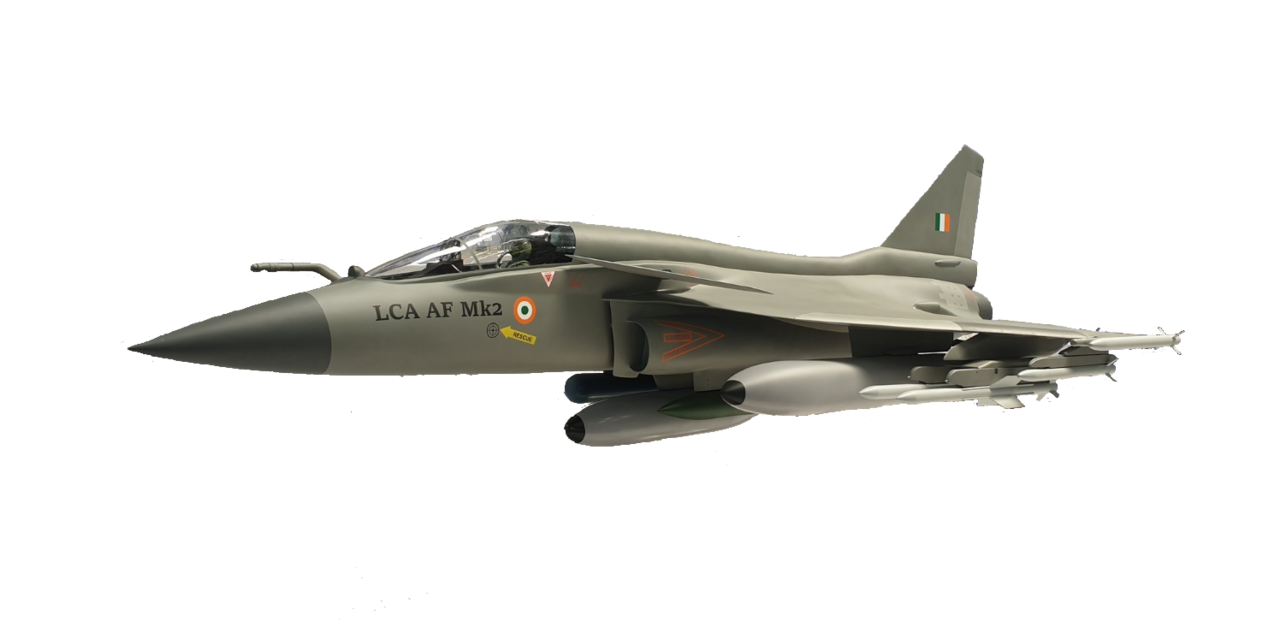
HAL Tejas is India’s indigenous single-engine, delta wing, multirole light fighter aircraft designed by the Aeronautical Development Agency (ADA) and produced by Hindustan Aeronautics Limited (HAL) for the Indian Air Force and Indian Navy.
Specifications
| Specification | Details |
|---|---|
| Type | Light Combat Aircraft (LCA) |
| Origin | India |
| Manufacturer | Hindustan Aeronautics Limited |
| Designer | Aeronautical Development Agency |
| First Flight | 2001 |
| Entered Service | 2016 (IAF), 2024 (IN) |
| Role | Multirole fighter |
| Crew | 1 (2 in trainer variant) |
Performance
- Max Speed: Mach 1.8 (1,920 km/h)
- Combat Range: 500 km
- Ferry Range: 3,000 km
- Service Ceiling: 15,200 m (50,000 ft)
- Rate of Climb: 270 m/s
Dimensions
- Length: 13.2 m
- Wingspan: 8.2 m
- Height: 4.4 m
- Wing Area: 38.4 m²
- Empty Weight: 6,560 kg
- Max Takeoff Weight: 13,500 kg
Armament
Guns
- 1× 23mm GSh-23 twin-barrel cannon (220 rounds)
Hardpoints
- 8 hardpoints with total capacity of 4,000 kg
Air-to-Air Missiles
- R-73 (short-range)
- R-77 (beyond visual range)
- Astra Mk-I/II (indigenous BVR)
- Python-5 (all-aspect)
Air-to-Ground
- Guided bombs (Israeli origin)
- Unguided rockets
- Anti-runway bombs
- Indigenous smart weapons
Anti-Ship
- Sea Eagle missiles (export variant)
Variants
Tejas Mk 1
- Initial operational variant
- Limited operational clearance (2013)
- Final operational clearance (2019)
- Status: In service with IAF
Tejas Mk 1A
- Advanced variant with AESA radar
- Enhanced avionics and weapons
- 83 aircraft ordered by IAF (2021)
- Status: Under production
Tejas Mk 2 (MWF)
- Medium Weight Fighter variant
- More powerful engine (GE F414)
- Increased payload capacity
- Status: Under development
Tejas Trainer
- Two-seat operational trainer
- Tandem cockpit configuration
- Fully combat-capable
- Status: Operational
Tejas Navy (NLCA)
- Carrier-capable variant
- Strengthened undercarriage
- Arrestor hook for deck landing
- Status: Under trials
Key Features
✈️ Advanced Design
- Compound delta wing
- Relaxed static stability
- Digital fly-by-wire control
- Lightweight composite materials
🎯 Avionics Suite
- Multi-Mode Radar (MMR)
- AESA radar (Mk 1A onwards)
- Glass cockpit with MFDs
- Helmet-mounted display
- Advanced EW suite
🛡️ Survivability
- Low radar cross-section
- Chaff and flare dispensers
- Radar warning receiver
- Missile approach warning
Indigenous Content
80%+ Indian Components (Mk 1A target: 60%)
- Airframe: Composite materials by Indian firms
- Avionics: Indian-developed systems
- Software: 100% indigenous
- Engine: GE F404 (foreign), GE F414 (Mk 2)
Key Indian Subsystems
- Digital Flight Control Computer (DFCC)
- Mission Computer
- Multi-Mode Radar
- Electronic Warfare Suite
- Composite structures
Operational History
Squadron Induction
- No. 45 Squadron “Flying Daggers” (2016)
- No. 18 Squadron “Flying Bullets” (2020)
- Additional squadrons planned
Combat Readiness
- Participated in Exercise Gagan Shakti (2018)
- Deployed to forward airbases
- Quick Reaction Alert (QRA) duty capable
International Exercises
- Participated in various air exercises
- Demonstration flights in several countries
Development Timeline
- 1983: LCA program initiated
- 1998: Prototype TD-1 rollout
- 2001: First flight
- 2011: Initial operational clearance
- 2016: Squadron induction (IAF)
- 2021: 83 Mk 1A order
- 2024: Navy variant trials
- 2027: Mk 2 first flight (expected)
Orders & Production
Current Orders
- IAF: 123 aircraft (40 Mk 1 + 83 Mk 1A)
- Indian Navy: 46 aircraft (10 trainers + 36 fighters)
- Total: 169 aircraft
Production Rate
- Current: 8 aircraft/year
- Target: 16 aircraft/year (2025)
- Goal: 24 aircraft/year (2027)
Export Potential
Countries Showing Interest
- Malaysia (evaluation)
- Egypt (negotiations)
- Argentina (discussions)
- Sri Lanka (interest expressed)
- Philippines (exploratory talks)
Competitive Advantages
- Lower operating costs
- Western-origin systems compatible
- No geopolitical strings attached
- Competitive pricing (~$40-45M per unit)
Strategic Significance
🇮🇳 Make in India Showcase
- Indigenous fighter aircraft program
- Technology self-reliance
- Aerospace ecosystem development
💪 Operational Independence
- Reduced import dependence
- Technology absorption
- Upgrade sovereignty
🌏 Regional Capability
- Light fighter role effectiveness
- Point defense operations
- Suitable for Indian operational environment
Challenges Overcome
✅ Development delays (technology sanctions) ✅ Engine development issues ✅ Weight optimization ✅ Carrier compatibility ✅ Export certification
Future Roadmap
Short Term (2024-2027)
- Complete Mk 1A deliveries
- Navy variant certification
- Export contract finalization
Medium Term (2027-2030)
- Mk 2 (MWF) induction
- AESA radar integration
- Indigenous engine testing
Long Term (2030+)
- Advanced variants
- AMCA stealth fighter (next gen)
- Export fleet growth
Comparison
| Aircraft | Role | Speed | Range | Origin |
|---|---|---|---|---|
| Tejas Mk 1A | Light | Mach 1.8 | 500 km | India |
| JF-17 Thunder | Light | Mach 1.6 | 1,300 km | Pakistan-China |
| F-16V | Multi | Mach 2.0 | 550 km | USA |
| Gripen E | Multi | Mach 2.0 | 1,300 km | Sweden |
Key Achievements
🏆 First indigenous supersonic fighter 🥇 Smallest & lightest in its class 🎯 Advanced composite airframe 💻 100% indigenous software 🛡️ Nuclear-capable platform 🌍 Export interest from 5+ countries
Last Updated: February 2026 Status: Operational (Mk 1), Production (Mk 1A) Deployed: 2 IAF Squadrons, Navy Trials Orders: 169 aircraft
HAL Tejas represents India’s journey towards self-reliance in combat aircraft development and positions India as an emerging aerospace power.