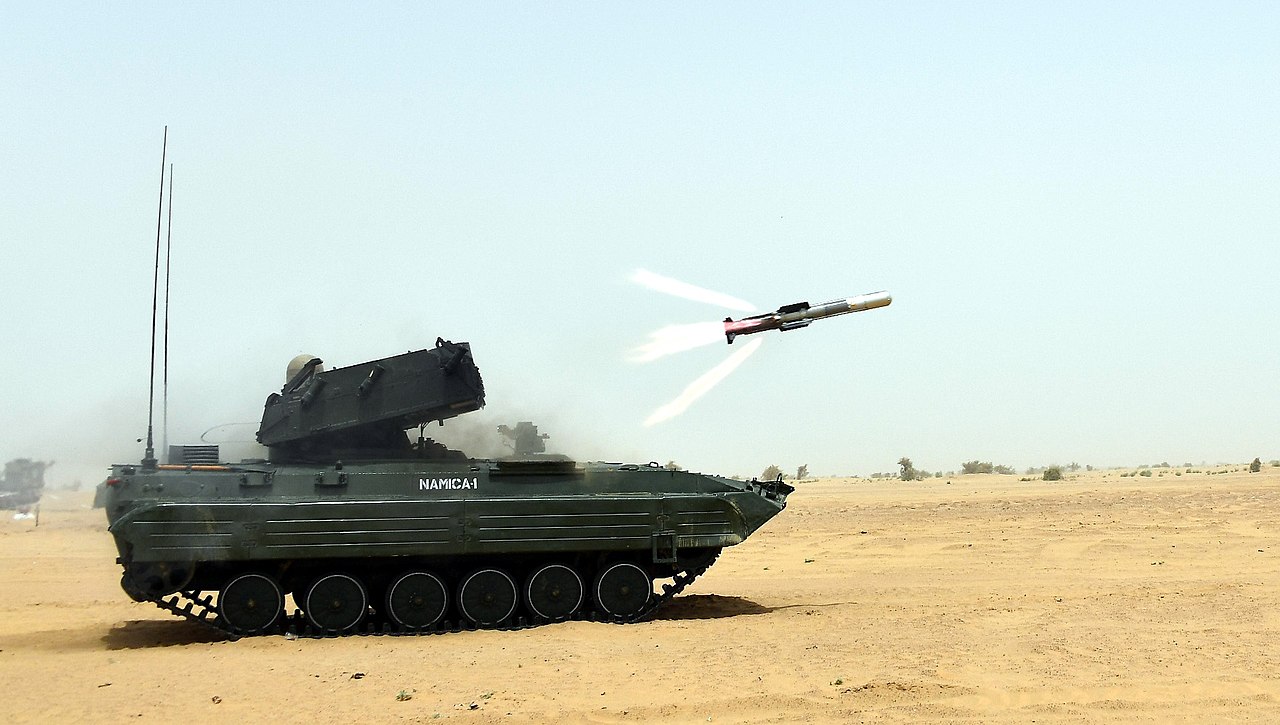
Overview
The NAG missile represents a significant leap in India’s indigenous missile technology, being the country’s first third-generation anti-tank guided missile (ATGM) developed entirely by the Defence Research and Development Organisation (DRDO). Designed to effectively neutralize modern armored threats, NAG introduces advanced fire-and-forget capabilities, enabling operators to launch the missile and immediately take cover or relocate. This feature is critical for survivability and operational flexibility on the modern battlefield.
Equipped with a state-of-the-art millimeter-wave (mmW) active radar homing seeker, the missile can autonomously detect and engage armored targets even under adverse weather and battlefield obscurants. The missile’s top-attack mode allows it to strike the relatively thinner armor on the upper surfaces of tanks and armored vehicles, significantly improving lethality against contemporary main battle tanks. Designed for versatility, NAG can be launched from multiple platforms including ground vehicles, helicopters, and tripod launchers, making it a flexible asset across various combat scenarios.
The successful induction of NAG into the Indian Army marks a milestone in India’s defense modernization and self-reliance initiatives under the Make in India program. It not only enhances the Army’s anti-armor capabilities but also reduces dependence on foreign missile systems, contributing to strategic autonomy in critical defense technologies.
Specifications
| Parameter | Details |
|---|---|
| Missile Type | Third-generation Anti-Tank Guided Missile (ATGM) |
| Length | ~1.85 meters |
| Diameter | 0.2 meters (approx.) |
| Weight | ~43 kg (missile only) |
| Warhead | Tandem shaped charge HEAT warhead |
| Range | 500 m to 4 km (typical operational range) |
| Guidance System | Fire-and-forget with Millimeter-wave active radar seeker |
| Seeker Frequency | Millimeter-wave radar (94 GHz band) |
| Flight Profile | Top-attack and direct attack modes |
| Launch Platforms | Ground vehicles (NAMICA), helicopters, tripod launchers |
| Propulsion | Solid-fuel rocket motor |
| Speed | Supersonic (~230 m/s) |
| Operational Temperature | -20°C to +55°C |
| Storage Life | 10 years (approximate) |
| Manufacturer | Defence Research and Development Organisation (DRDO), India |
| Service Entry | 2020 (Indian Army) |
Key Features
- 🚀 Fire-and-Forget Capability: Enables the operator to disengage immediately after launch, increasing survivability in hostile environments.
- 🎯 Millimeter-Wave Active Radar Seeker: Provides all-weather, day-night target acquisition and tracking with high precision.
- 🛡️ Top-Attack Mode: Engages armored vehicles by striking their most vulnerable upper armour, enhancing kill probability.
- 🛠️ Versatile Platform Integration: Compatible with ground-based vehicles (like NAMICA), helicopters, and tripod launchers for flexible deployment.
- 🇮🇳 Indigenous Development: Entirely developed in India under the Nag Missile Development Programme, supporting Make in India and defense self-reliance.
- 📡 Advanced Target Discrimination: Capable of distinguishing between tanks, bunkers, and other armored targets even in cluttered environments.
Variants
| Variant Name | Description |
|---|---|
| NAMICA-Nag | Vehicle-mounted launcher integrated on a modified BMP-2 chassis for rapid battlefield deployment. |
| Helina | Helicopter-launched variant of NAG, designed for launch from HAL Dhruv and other platforms, with extended range (~7 km). |
| Prajwal | Man-portable missile system with tripod launcher, designed for infantry use with similar guidance and warhead. |
| LR-NAG | Long-range variant under development, aiming to extend operational range beyond 7 km. |
Operational Status
- The NAG missile was officially inducted into the Indian Army in 2020 following extensive trials.
- Currently deployed with anti-tank units equipped with NAMICA (Nag Missile Carrier) vehicles.
- The helicopter-launched variant Helina has been tested successfully and is in advanced stages of induction with the Indian Air Force and Army Aviation Corps.
- Prajwal and other man-portable systems are under various stages of testing and evaluation.
- The system has been operationally deployed along sensitive border areas and is actively enhancing India’s anti-armor defense posture.
Development Timeline
| Date | Milestone |
|---|---|
| 1988 | Nag Missile Development Programme initiated by DRDO |
| 2007 | First successful test of Nag missile prototype |
| 2014 | Successful trials of NAMICA vehicle integration |
| 2015 | Fire-and-forget capability demonstrated in tests |
| 2017 | Helicopter-launched variant (Helina) test fires |
| 2020 | Official induction into Indian Army |
| 2022 | Continued user trials and enhancements on Helina |
| 2024 | Development of extended-range LR-NAG commenced |
Strategic Significance
The induction of the NAG missile is a watershed moment for India’s ground warfare capabilities. By fielding a reliable, indigenous third-generation ATGM, India significantly strengthens its anti-tank warfare posture against heavily armored adversaries. This capability is crucial given the dynamic threat environment along India’s borders where armored incursions are a serious concern.
The missile enhances tactical flexibility by allowing rapid deployment from multiple platforms, thus enabling forces to counter tank columns, bunkers, and fortified positions effectively. Being a fire-and-forget weapon, it reduces operator exposure to counter-fire and enables faster repositioning, improving battlefield survivability.
Moreover, NAG’s development reflects India’s commitment to reducing reliance on foreign suppliers for critical defense systems, aligning with the government’s vision of Atmanirbhar Bharat (self-reliant India). This program has also bolstered India’s indigenous defense industrial base, fostering advanced research and manufacturing capabilities within the country.
Future Upgrades
- LR-NAG: Development of a long-range variant with an operational range exceeding 7 km for extended stand-off engagements.
- Dual Seeker Integration: Research into combining millimeter-wave radar with imaging infrared seekers for improved target acquisition in complex environments.
- Network-Centric Warfare: Integration with battlefield management systems for real-time target data sharing and coordinated strikes.
- Reduced Weight & Enhanced Mobility: Ongoing efforts to reduce missile weight for better portability and ease of deployment by infantry.
- Improved Warhead: Development of multi-purpose tandem warhead variants to defeat reactive armor and fortified positions.
Comparison Table
| Feature | NAG (India) | TOW 2B (USA) | Kornet-E (Russia) |
|---|---|---|---|
| Generation | Third-generation, fire-and-forget | Second-generation, wire-guided | Third-generation, laser-guided |
| Guidance System | Millimeter-wave active radar seeker | Wire-guided, SACLOS | Laser beam riding |
| Range | 0.5 - 4 km (current), LR variant >7 km | ~3.75 km | ~5.5 km |
| Warhead | Tandem HEAT | Tandem HEAT | Tandem HEAT |
| Launch Platforms | Vehicle, helicopter, tripod | Vehicle, tripod, helicopter | Vehicle, tripod, helicopter |
| Fire-and-Forget | Yes | No | Yes |
| Top-Attack Capability | Yes | Limited | Yes |
| Indigenous Development | Fully indigenous (DRDO) | Foreign origin | Foreign origin |
Key Takeaways
- ✅ India’s first indigenous third-generation ATGM with fire-and-forget and top-attack modes.
- 🎯 Equipped with millimeter-wave radar seeker for autonomous target acquisition in all conditions.
- 💪 Versatile launch capabilities from ground vehicles, helicopters, and infantry tripods.
- 🇮🇳 Major boost to India’s defense self-reliance and modernization under Make in India.
- 🚀 Significant enhancement of Indian Army’s anti-armor warfare and battlefield survivability.
- 🔧 Continuous upgrades planned including extended-range and multi-sensor seekers.
Last updated: March 1, 2026
Status: Operational with Indian Army, ongoing upgrades in development
Deployment: Active deployment in sensitive border sectors, integrated on NAMICA vehicles and helicopter platforms.
References:
- DRDO official releases and Nag missile test reports
- Indian Army press briefings on NAG induction
- Jane’s Defence Weekly
- SIPRI Arms Transfers Database
- Press Information Bureau (PIB), Government of India
- Indian Defense Review journals