Overview
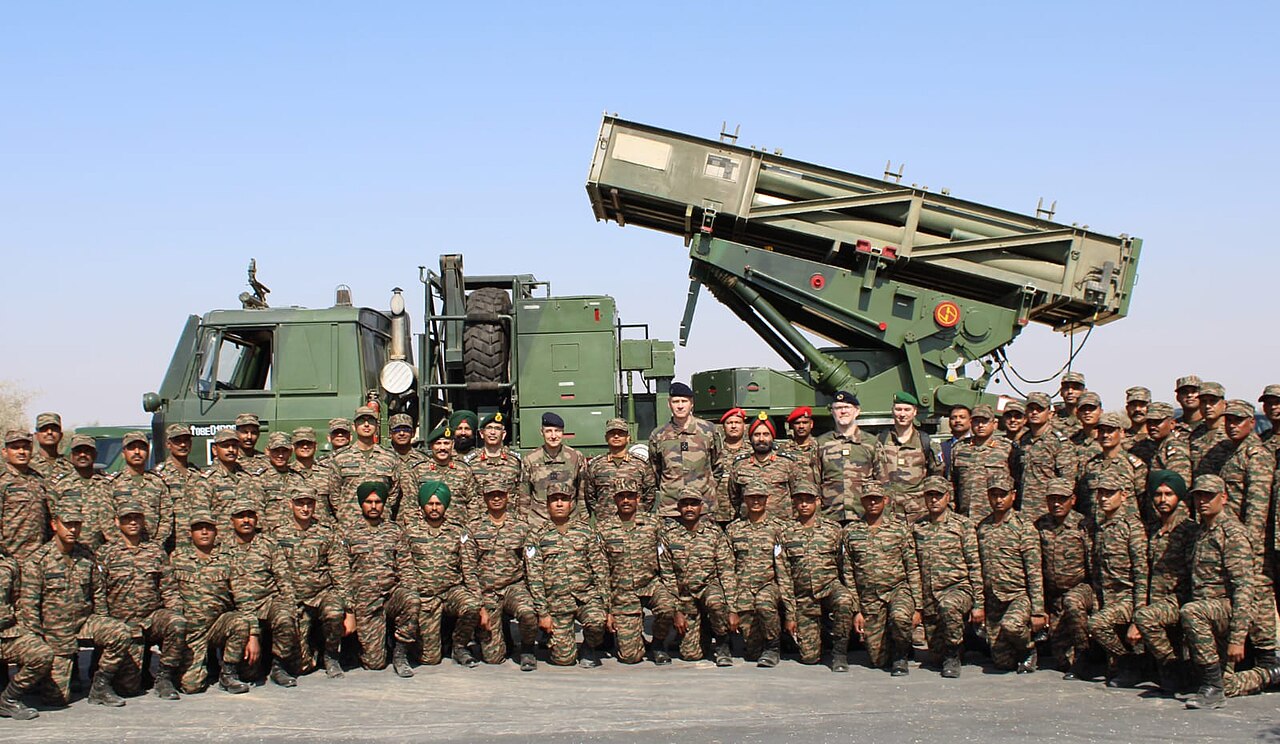
The Pinaka Mk I Multiple Rocket Launcher System (MRLS) represents a landmark achievement in India’s indigenous artillery development. Designed and developed by the Defence Research and Development Organisation (DRDO) under the Armament Research and Development Establishment (ARDE), Pinaka Mk I entered service in the late 1990s and became the Indian Army’s primary long-range rocket artillery system. It was developed to provide rapid, high-volume saturation bombardment capability to support combined arms operations and enhance firepower over conventional tube artillery.
Pinaka’s design was driven by the need to replace the older BM-21 Grad systems and to create an indigenous launcher capable of firing a salvo of 12 rockets within 44 seconds with a range initially around 40 km. The system is mounted on a highly mobile Tatra 6x6 truck and integrates an automated fire control system, enabling rapid deployment, high mobility, and adaptability across diverse Indian terrains—from deserts to mountainous regions. Pinaka Mk I has proven its mettle in multiple exercises and operational deployments, providing the Indian Army with a potent and reliable saturation bombardment weapon.
While the upgraded Pinaka Mk II variant with extended range and enhanced accuracy is now in production and deployment, the Mk I remains operationally relevant and widely deployed. It continues to be a workhorse of India’s artillery formations, symbolizing the success of “Make in India” in the domain of rocket artillery.
Specifications
| Parameter | Specification |
|---|---|
| System Type | Multiple Rocket Launcher System (MRLS) |
| Country of Origin | India |
| Manufacturer | Defence Research and Development Organisation (DRDO), Larsen & Toubro (L&T) (Production) |
| Launch Vehicle | Tatra 6x6 truck chassis |
| Number of Launch Tubes | 12 |
| Rocket Caliber | 214 mm |
| Rocket Length | Approx. 3 meters |
| Rocket Weight | Approx. 250 kg |
| Warhead Type | High Explosive Fragmentation (HE-FRAG) |
| Warhead Weight | Approx. 45 kg |
| Maximum Range | ~40 km (initially) |
| Accuracy | ~1-2% CEP (Circular Error Probable) |
| Firing Mode | Salvo (all 12 rockets in 44 seconds) |
| Reload Time | Approx. 20 minutes |
| Crew | 6-9 personnel |
| Mobility | High (Tatra 6x6 truck) |
| Fire Control System | Automated, GPS and inertial navigation aided |
| Deployment Time | Less than 3 minutes |
| Communication System | Secure radio communication |
| Operating Temperature Range | -40°C to +55°C |
Key Features
🚀 Rapid Saturation Firepower
- Capable of firing 12 rockets in a rapid salvo within 44 seconds, delivering a high volume of explosive firepower on target areas, essential for suppressing enemy formations and artillery.
🎯 Indigenous Design & Production
- Entirely developed indigenously by DRDO with serial production by Indian private sector partners under “Make in India,” reducing dependency on foreign suppliers and boosting domestic defense manufacturing.
🛡️ High Mobility & Terrain Adaptability
- Mounted on a robust Tatra 6x6 truck chassis, it offers excellent off-road mobility capable of operating across diverse terrains including deserts, plains, and high-altitude mountainous regions.
🔄 Quick Deployment & Reload
- The system can be deployed, fired, and relocated within minutes, enhancing survivability against counter-battery fire. Reload time is approximately 20 minutes, allowing sustained operations.
📡 Integrated Fire Control System
- Features an automated fire control system with GPS and inertial navigation to improve firing accuracy and rapid targeting, enabling coordinated barrage in combined arms scenarios.
Variants
| Variant | Description |
|---|---|
| Pinaka Mk I | Original system with ~40 km range, 12 rockets per salvo, high mobility. |
| Pinaka Mk II | Advanced variant with extended range (~60-75 km), improved accuracy, and enhanced rocket design (documented separately). |
Operational Status
Pinaka Mk I has been in service with the Indian Army since the late 1990s and continues to be widely deployed across various artillery regiments. It has seen operational deployment in border sectors, integrated into combined arms operations, and participated extensively in military exercises demonstrating rapid saturation bombardment capability. The system is considered battle-proven and remains a vital component of India’s long-range artillery firepower, complementing tube artillery and newer rocket systems.
Its rugged mobility and ease of operation have made it indispensable for terrain-challenging deployments, especially in the western desert and northern mountainous borders. Production and induction have been ongoing with several hundred launchers and thousands of rockets delivered.
Development Timeline
| Year | Milestone |
|---|---|
| 1980s | Conceptualization and early development initiated by DRDO and ARDE |
| 1994 | Pinaka Mk I prototype completed |
| 1996 | Successful trials and validation |
| 1998 | Induction into Indian Army service |
| 2000-2010 | Serial production by Larsen & Toubro and deployment across artillery regiments |
| 2010+ | Incremental upgrades to fire control and mobility systems |
| 2015 | Development of Pinaka Mk II variant began |
| Present | Pinaka Mk I remains in active service alongside Mk II |
Strategic Significance
Pinaka Mk I revolutionized Indian artillery capabilities by introducing an indigenous, rapid-firing rocket artillery system capable of saturating enemy positions at long ranges. It filled a critical gap by providing the Indian Army with a potent weapon capable of delivering a large volume of explosives over a wide area in a short period, thus shaping battlefield dynamics in India’s favor.
The system’s indigenous development under DRDO has bolstered India’s self-reliance in artillery technology and reduced dependence on foreign rocket artillery imports. Its mobility and ease of deployment enhance operational flexibility along India’s diverse and challenging borders. The Pinaka system has become a key enabler for integrated combined arms operations, supporting infantry and armored maneuvers with suppressive fire.
Future Upgrades
Although the Pinaka Mk II variant is the focus of future enhancements, the Pinaka Mk I system is slated for incremental upgrades to extend its lifecycle and operational effectiveness. Planned improvements include:
- Integration of enhanced fire control and navigation systems for improved accuracy.
- Modernization of communication suites for network-centric warfare compatibility.
- Development of new rocket warhead types, including cluster munitions and guided variants.
- Reduction in reload times through automated handling systems.
These upgrades will ensure the continued relevance of Pinaka Mk I in the Indian Army’s artillery inventory even as newer systems are inducted.
Comparison Table
| Feature | Pinaka Mk I | BM-21 Grad (Imported) | Pinaka Mk II |
|---|---|---|---|
| Country of Origin | India (Indigenous) | Soviet Union / Russia | India (Indigenous) |
| Caliber | 214 mm | 122 mm | 214 mm |
| Number of Tubes | 12 | 40 | 12 |
| Max Range | ~40 km | ~20-30 km | ~60-75 km |
| Reload Time | ~20 minutes | ~10-15 minutes | ~15 minutes |
| Mobility | High (Tatra 6x6 truck) | Medium (ZIL-131 truck) | High (Tatra 6x6 truck) |
| Warhead Types | HE-FRAG | HE-FRAG | HE-FRAG, Guided variants |
| Indigenous | ✅ | ❌ | ✅ |
Key Takeaways
- 🚀 Rapid salvo firing: 12 rockets in under a minute for powerful saturation bombardment.
- 🇮🇳 Fully indigenous system: Major milestone in India’s self-reliance in rocket artillery.
- 🛻 Highly mobile: Operates effectively across diverse and challenging terrains.
- 🎯 Integral to Indian Army: Backbone of rocket artillery firepower since late 1990s.
- 🔄 Continued upgrades: Ensures relevance alongside advanced Pinaka Mk II variant.
- ✅ Proven operational effectiveness: Widely deployed in multiple artillery regiments.
Last updated: February 2026
Status: Active Service
Deployment: Indian Army Artillery Regiments across border sectors and training commands
Sources:
- Defence Research and Development Organisation (DRDO) Publications
- Indian Army Official Releases
- Jane’s Land Warfare Platforms - Artillery & Air Defence
- Press Information Bureau (PIB), Government of India
- Defense industry analysis reports on Indian MRLS systems