Overview
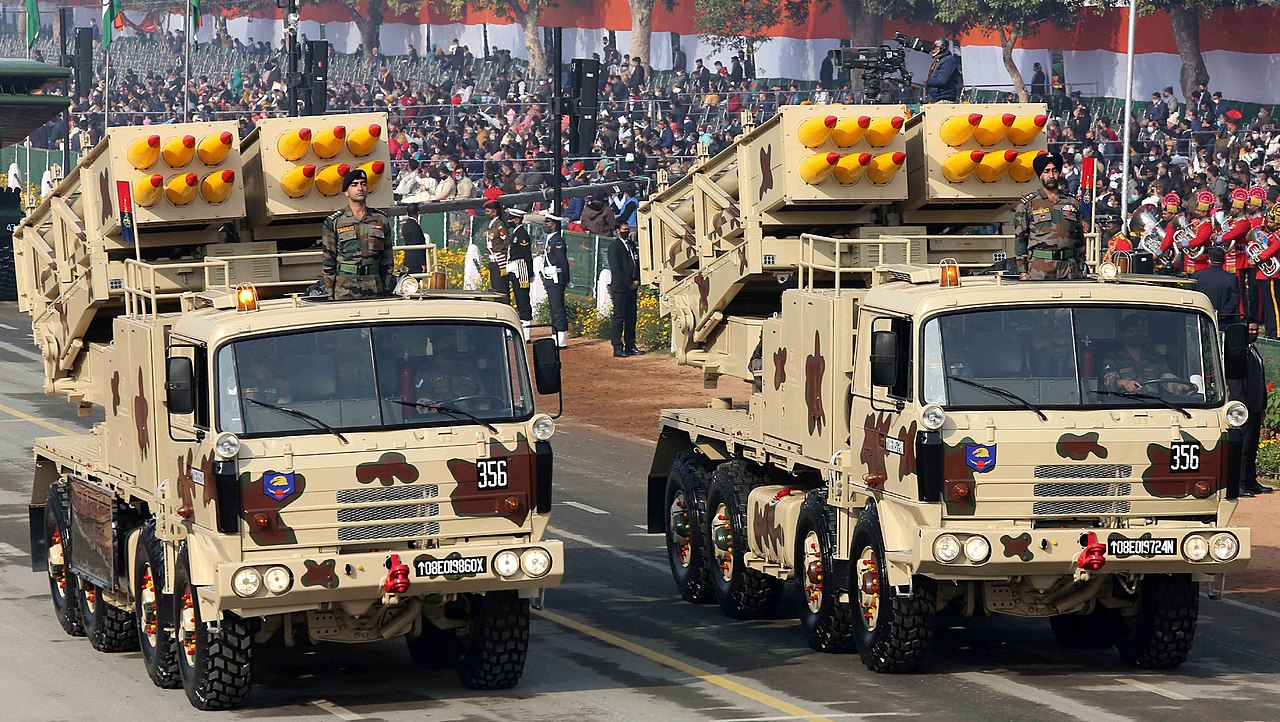
The Pinaka Mk II is the latest evolution of India’s indigenous multiple rocket launcher system (MRLS), developed by the Defence Research and Development Organisation (DRDO) in collaboration with Indian industry. It is designed to significantly enhance the Indian Army’s artillery firepower by providing extended range, higher precision, and improved lethality compared to the original Pinaka Mk I system. The Mk II variant reflects India’s commitment to modernizing its land systems with cutting-edge technology, ensuring better battlefield effectiveness and operational flexibility.
Building on the success of the Pinaka Mk I, which saw extensive deployment since the early 2000s, the Mk II version boasts an extended range of up to 60 kilometers, nearly doubling the reach of its predecessor. This increase in range enables the Indian Army to engage targets deeper behind enemy lines while staying outside the effective range of most counter-battery fire. Enhanced accuracy is achieved through the integration of advanced navigation and guidance systems, such as an onboard inertial navigation system (INS) coupled with GPS, resulting in a significant reduction in circular error probable (CEP).
The Pinaka Mk II system comprises a launcher vehicle mounting 12 rocket tubes, supported by a dedicated command post vehicle, replenishment vehicles, and a comprehensive fire control system. Fully developed and produced indigenously, the system underlines the success of India’s ‘Make in India’ initiative in defense technology, reducing reliance on foreign suppliers and enhancing self-sufficiency.
Specifications
| Parameter | Pinaka Mk II |
|---|---|
| Type | Multiple Rocket Launcher System (MRLS) |
| Manufacturer | DRDO, Indian Industry (Tata Power SED, etc.) |
| Caliber | 214 mm |
| Number of Tubes | 12 |
| Rocket Length | Approx. 7 meters |
| Warhead Types | High Explosive Fragmentation, Improved HE, Cluster, Smoke, etc. |
| Rocket Range | Up to 60 km (Mk II) |
| Guidance System | INS + GPS (Enhanced Accuracy) |
| CEP (Circular Error Probable) | <50 meters |
| Reload Time | ~20 minutes |
| Launcher Vehicle | 8x8 Tatra or Ashok Leyland chassis |
| Weight (Launcher) | Approx. 26 tons |
| Firing Modes | Single rocket, salvo, ripple fire |
| Fire Control System | Automated with digital interface |
| Crew | 6-7 personnel |
| Mobility | Cross-country capable, 80 km/h road speed |
| Operational Temperature | -40 °C to +55 °C |
| Deployment Time | Less than 3 minutes |
Key Features
🚀 Extended Range and Lethality
- Rockets capable of striking targets up to 60 km away, nearly doubling the range of the original Pinaka Mk I.
- Multiple warhead options including improved high-explosive fragmentation for maximum damage, cluster munitions for area suppression, and specialized warheads for smoke and illumination.
🎯 Advanced Guidance and Accuracy
- Equipped with an INS + GPS guidance system that offers a CEP of under 50 meters, significantly enhancing precision strike capability.
- Digital fire control system enables rapid targeting and salvo firing modes, allowing flexible engagement profiles.
💪 Indigenous Development and Production
- Entire system developed and produced domestically by DRDO and Indian private/public sector companies under the ‘Make in India’ initiative.
- Launcher vehicles use robust, all-terrain 8x8 platforms manufactured by Indian industry, ensuring high mobility and reliability.
🛡️ Rapid Deployment and Reload
- Quick setup and firing readiness within 3 minutes, enabling shoot-and-scoot tactics to evade counter-battery fire.
- Reload time reduced to approximately 20 minutes with specialized replenishment vehicles, maintaining high operational tempo.
Variants
| Variant | Description |
|---|---|
| Pinaka Mk I | Original version, range up to 40 km, unguided rockets, operational since early 2000s. |
| Pinaka Mk II | Enhanced version with extended range (up to 60 km), guided rockets, improved warheads, and digital fire control. |
| Pinaka Mk II ER | Extended range variant under development with expected range beyond 75 km, incorporating next-generation propulsion and guidance. |
Operational Status
- The Pinaka Mk II has been inducted into the Indian Army since 2022, with multiple regiments equipped across different artillery brigades.
- It has been successfully deployed during large-scale exercises and is operational in forward areas, complementing the existing artillery and rocket artillery assets.
- The system has also been showcased in international defense expos, highlighting India’s growing indigenous artillery manufacturing capabilities.
Development Timeline
| Year | Milestone |
|---|---|
| 1999 | Pinaka Mk I development initiated by DRDO. |
| 2006 | Pinaka Mk I inducted into Indian Army. |
| 2015 | Concept and preliminary design for Pinaka Mk II started. |
| 2018 | Successful test firings of extended range guided rockets. |
| 2020 | Completion of user trials and validation of Mk II system. |
| 2022 | Official induction of Pinaka Mk II into Indian Army. |
| 2024 | Continued production ramp-up and integration of enhanced warheads. |
Strategic Significance
The Pinaka Mk II represents a critical component of India’s artillery modernization program, which aims to equip the Indian Army with precision-guided, long-range rocket artillery capable of rapid, high-volume firepower deployment. Its indigenous development ensures strategic autonomy and reduces dependence on foreign suppliers for critical artillery systems.
With its extended range and enhanced accuracy, Pinaka Mk II can engage enemy formations, infrastructure, and artillery assets deep behind lines with minimal collateral damage. This capability is especially vital given India’s varied and challenging border terrain, allowing for effective stand-off engagements in both mountainous and plains environments.
The system’s mobility and rapid deployment features also improve survivability against counter-battery strikes, enhancing overall battlefield effectiveness. Additionally, the Mk II’s modular architecture and digital fire control systems allow integration with modern battlefield management systems, supporting network-centric warfare capabilities.
Future Upgrades
- Development of Pinaka Mk II ER (Extended Range) variant targeting a range beyond 75 km with improved propulsion and navigation systems.
- Integration of smart munitions and enhanced multi-mode seekers for target discrimination and reduced collateral damage.
- Enhanced automation in fire control and logistical support to reduce crew workload and increase firing efficiency.
- Potential incorporation of artificial intelligence (AI) for improved target acquisition, threat prioritization, and autonomous firing decisions.
Comparison Table
| Feature | Pinaka Mk I | Pinaka Mk II | BM-30 Smerch (Russia) |
|---|---|---|---|
| Range | ~40 km | Up to 60 km | ~90 km |
| Guidance | Unguided | INS + GPS | INS + GPS |
| Warhead Types | HE Fragmentation | Improved HE, Cluster | HE, Cluster, Thermobaric |
| CEP | ~250 m | <50 m | ~70 m |
| Reload Time | ~30 minutes | ~20 minutes | ~20 minutes |
| Mobility | 8x8 Truck | 8x8 Truck | 8x8 Truck |
| Indigenous Content | ~80% | >90% | Foreign |
| Deployment | Indian Army | Indian Army | Various countries |
Key Takeaways
- ✅ Extended range of up to 60 km enhances artillery reach and battlefield dominance.
- 🎯 Advanced guidance system ensures precision strikes with a CEP under 50 meters.
- 💪 Fully indigenous development boosts India’s defense self-reliance and ‘Make in India’.
- 🛡️ Rapid deployment and reload allow shoot-and-scoot tactics for survivability.
- ⚙️ Versatile warheads enable a wide spectrum of mission profiles from area suppression to targeted strikes.
- 🕹️ Digital fire control integrates seamlessly with modern command and control infrastructure.
Last updated: February 2026
Status: In active service with Indian Army
Deployment: Multiple artillery regiments deployed across varied terrains in India
Sources and References:
- DRDO official publications and press releases
- Indian Army modernization reports (2020-2026)
- Jane’s Land Warfare Platforms: Artillery & Air Defence
- The Diplomat, Defense News, and Indian defense industry analyses