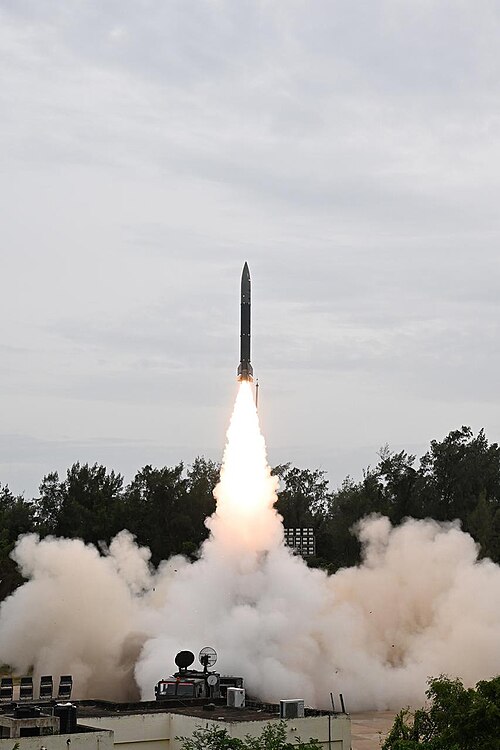
Overview
Pralay is a cutting-edge surface-to-surface tactical ballistic missile developed indigenously by India’s Defence Research and Development Organisation (DRDO). Conceived to fill the operational gap between short-range ballistic missiles like Prahaar and medium-range systems such as the Agni series, Pralay offers a strategic advantage by providing quick-reaction, highly accurate strikes with a range of approximately 150 to 500 kilometers. Its induction marks a crucial step forward in modernizing India’s missile arsenal, emphasizing precision, mobility, and rapid deployment.
Designed to be launched from mobile platforms, Pralay enhances battlefield flexibility and survivability, enabling the Indian Armed Forces to conduct swift tactical strikes against high-value targets in enemy territory. Equipped with advanced guidance and navigation systems, the missile boasts high accuracy, capable of carrying conventional warheads with sophisticated precision strike capabilities. This indigenous missile system underlines India’s commitment to self-reliance in defense technology and strengthens deterrence posture along strategic frontiers.
The missile’s development reflects a concerted effort to address evolving battlefield requirements, including the need for quick-reaction tactical strikes with minimal collateral damage. Pralay’s blend of range, speed, and accuracy fills a critical niche in India’s missile inventory and complements existing systems, enhancing the overall strategic and tactical missile framework.
Specifications Table
| Parameter | Specification |
|---|---|
| Missile Type | Surface-to-Surface Tactical Ballistic Missile |
| Developer | Defence Research and Development Organisation (DRDO) |
| Length | ~7 meters (estimated) |
| Diameter | ~0.6 meters (estimated) |
| Launch Platform | Mobile Transporter Erector Launcher (TEL) |
| Range | 150 – 500 km |
| Warhead Type | Conventional High Explosive (HE) |
| Warhead Weight | ~500 kg (typical) |
| Propulsion | Solid-fuel rocket motor |
| Guidance System | INS/GPS aided inertial navigation with terminal guidance |
| Accuracy (CEP) | <10 meters (estimated) |
| Flight Time | Approximately 5–10 minutes (depending on range) |
| Speed | Mach 3+ (estimated) |
| Deployment Status | Inducted and operational |
| Operational Range Environment | All-weather, day/night capability |
Key Features
🚀 Extended Tactical Range
Pralay’s 150 to 500 km range strategically bridges the gap between short-range tactical missiles like Prahaar (150 km) and the longer-range Agni missiles. This allows for flexible targeting options deep within adversary tactical depth.
🎯 Precision Strike Capability
Equipped with advanced inertial navigation system (INS) supplemented by satellite navigation (GPS/IRNSS), Pralay achieves high accuracy with a Circular Error Probable (CEP) of less than 10 meters, enabling precise targeting of enemy assets with minimal collateral damage.
🛡️ Quick Deployment and Mobility
Designed to be launched from highly mobile transporter erector launchers (TELs), Pralay ensures rapid reaction and shoot-and-scoot capability, enhancing survivability against counter-battery fire and enemy pre-emptive strikes.
🔧 Indigenous Technology and Make in India
Pralay is a testament to India’s indigenous missile development capabilities, with design, propulsion, guidance, and warhead technologies developed domestically by DRDO and partner industries under the Make in India initiative.
Variants
As of 2026, Pralay is primarily fielded as a single variant tactical ballistic missile system. However, ongoing research aims to explore potential variants including:
- Pralay-NG (Next Generation): Expected to feature extended range beyond 500 km, improved guidance, and enhanced payload flexibility.
- Pralay-ER (Extended Range): A possible variant aimed at increasing strike depth to 700-800 km using advanced propulsion technologies.
- Pralay-R (Reduced Range): Tactical variant optimized for shorter range quick strikes with faster reaction time.
Operational Status
Pralay has been inducted into the Indian Army’s arsenal and is currently operational with frontline missile units. It has successfully undergone multiple test firings validating its range, accuracy, and reliability under diverse environmental conditions. The missile system enhances the Indian Army’s ability to conduct precision strikes against tactical and operational targets across the border, especially along the western and northern fronts.
The deployment of Pralay complements existing missile systems by providing a flexible, quick-reaction tactical capability with a precision strike profile. Its mobile TEL launchers are deployed in strategic areas to maximize coverage and responsiveness.
Development Timeline
| Year | Milestone |
|---|---|
| 2017 | Project conceptualization and initial design phase |
| 2019 | First successful flight tests of Pralay missile |
| 2021 | Integration of advanced guidance and terminal navigation systems |
| 2022 | Final user trials and validation by Indian Army |
| 2023 | Formal induction into Indian Army tactical missile units |
| 2024-2025 | Ongoing enhancements and production ramp-up |
| 2026 | Operational deployment and integration into battlefield architecture |
Strategic Significance
Pralay fills a critical void in India’s missile triad by bridging the gap between short-range tactical missiles and longer-range ballistic systems. Its induction significantly enhances India’s ability to conduct precision tactical strikes with rapid deployment, offering a credible deterrent against adversaries in regional conflict scenarios.
The missile’s indigenous development underscores India’s growing self-reliance in advanced missile technologies, reducing dependency on foreign suppliers and boosting strategic autonomy. Furthermore, Pralay’s deployment strengthens India’s deterrence posture by providing flexible options for conventional strikes without resorting to nuclear escalation.
By enabling rapid strike capability against critical enemy assets, command centers, and logistical nodes within the 150-500 km range, Pralay improves battlefield dominance and operational effectiveness of the Indian Armed Forces.
Future Upgrades
- Enhanced Guidance Systems: Integration of advanced seekers such as radar or imaging infrared (IIR) for improved terminal phase accuracy and target discrimination.
- Extended Range Variants: Developing versions with ranges exceeding 600 km, incorporating new propulsion technologies for deeper strike capabilities.
- Multiple Warhead Options: Capability to carry submunition or cluster warheads for area denial and anti-armor roles.
- Integration with Network-Centric Warfare: Real-time data link upgrades for mid-course corrections and improved target updates.
- Reduced Launch Signature: Technologies aimed at minimizing launch detectability to improve system survivability.
Comparison Table
| Feature | Pralay | Prahaar | Agni-1 |
|---|---|---|---|
| Range | 150 – 500 km | ~150 km | 700 – 900 km |
| Warhead Type | Conventional HE | Conventional HE | Nuclear/Conventional |
| Guidance System | INS + GPS/IRNSS + Terminal | INS + GPS | INS + Satellite Navigation |
| Mobility | Mobile TEL | Mobile TEL | Road and rail-mobile |
| Accuracy (CEP) | <10 meters | ~10 meters | 10-20 meters |
| Deployment | Indian Army (tactical units) | Indian Army | Strategic forces |
| Role | Tactical ballistic missile | Short-range tactical missile | Medium-range ballistic missile |
Key Takeaways
- ✅ Bridges the tactical missile gap between short-range and medium-range ballistic systems.
- 🎯 High precision strike capability with CEP under 10 meters.
- 💪 Indigenous and mobile system enhancing rapid deployment and survivability.
- 🚀 Solid-fueled missile capable of delivering conventional warheads up to 500 km.
- 🛡️ Enhances India’s strategic deterrence and battlefield dominance.
- 🔧 Developed under Make in India initiative strengthening self-reliance.
Last updated: February 2026
Status: Operational and inducted into Indian Army
Deployment: Frontline tactical missile units across strategic border sectors