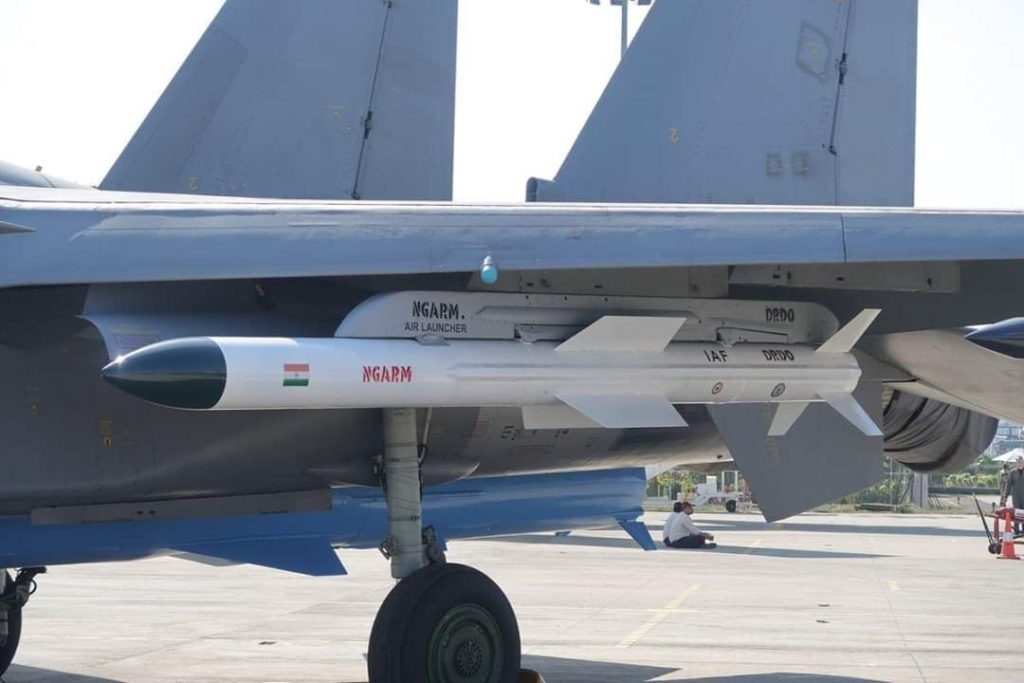
Rudram-1: India’s Indigenous Anti-Radiation Missile
Overview
Rudram-1 marks a significant milestone in India’s journey towards self-reliance in advanced electronic warfare and missile technology. Developed by the Defence Research and Development Organisation (DRDO), Rudram-1 is India’s first indigenously designed anti-radiation missile (ARM), aimed at detecting, homing, and neutralizing enemy radar and communication systems. This capability is vital for Suppression of Enemy Air Defenses (SEAD) missions, where neutralizing hostile radar installations reduces the threat posed to Indian Air Force (IAF) aircraft during combat operations.
Designed with cutting-edge seeker technology capable of autonomous detection and tracking of radar emissions, Rudram-1 provides a precise, long-range strike capability against enemy surface-to-air missile (SAM) sites, early warning radars, and communication nodes. With an operational range of approximately 100 kilometers, the missile enhances the survivability of Indian fighter aircraft by engaging threats from a safe standoff distance, thus ensuring air superiority in contested environments.
Rudram-1 is a key component in India’s electronic warfare arsenal and is slated for integration with multiple frontline Indian fighter platforms, including the Su-30MKI and the Tejas Light Combat Aircraft. This indigenous ARM complements existing air-to-air and air-to-surface weapons, reinforcing India’s strategic autonomy and reducing dependence on foreign missile systems.
Specifications
| Parameter | Details |
|---|---|
| Type | Anti-Radiation Missile (ARM) |
| Developer | Defence Research and Development Organisation (DRDO) |
| Length | ~4.0 meters (estimated) |
| Diameter | ~0.25 meters (estimated) |
| Launch Platform | Air-launched (fighter aircraft) |
| Range | ~100 km |
| Guidance System | Passive radar homing seeker (autonomous) |
| Warhead | High-explosive fragmentation |
| Propulsion | Solid-fuel rocket motor |
| Speed | Supersonic (estimated Mach 2+) |
| Target Type | Enemy radar and communication systems |
| Operational Altitude | Medium to high altitude |
| Integration Platforms | Su-30MKI, HAL Tejas, Mirage 2000 (planned) |
| Status | Development completed, limited induction |
| Country of Origin | India |
Note: Some technical parameters remain classified or approximate based on available public information.
Key Features
🚀 Indigenous Design & Development
- ✅ Fully developed by DRDO under the Make in India initiative.
- ✅ Represents India’s first indigenous anti-radiation missile, reducing reliance on foreign arms imports.
🎯 Advanced Targeting & Guidance
- 🎯 Passive radar homing seeker tracks and homes onto enemy radar emissions autonomously.
- 🎯 Capable of targeting a wide range of hostile radar systems including SAM radars, early warning radars, and communication arrays.
- 🎯 Enables stand-off engagement, allowing launch aircraft to remain outside the range of enemy air defenses.
🛡️ Enhanced Survivability & SEAD Capability
- 🛡️ Improves survivability of Indian Air Force fighter jets by neutralizing high-threat radars.
- 🛡️ Integral to Suppression of Enemy Air Defenses (SEAD) missions, ensuring safer air operations.
- 🛡️ Can be integrated on multiple fighter platforms, increasing operational flexibility.
Variants
As of 2026, Rudram-1 is the primary variant under development and initial induction. Future variants and improvements under consideration include:
| Variant | Description | Status |
|---|---|---|
| Rudram-1 | Base ARM version with passive radar homing | Operational/Induction |
| Rudram-1A | Planned extended range and enhanced seeker sensitivity | Under development |
| Rudram-1B | Integration variant optimized for different platforms (e.g., Tejas) | Testing phase |
Operational Status
Rudram-1 has successfully completed various flight trials demonstrating its seeker capability, range, and reliability. It is currently in the advanced stages of induction with the Indian Air Force, with operational deployment planned on Su-30MKI fighter jets initially. Integration trials with HAL Tejas and Mirage 2000 platforms are ongoing to expand its operational footprint.
The missile has undergone live firings in simulated combat scenarios, validating its ability to home onto active radar emitters and destroy them with high precision. While formal induction ceremonies are anticipated in the near future, Rudram-1 is considered a critical asset in enhancing India’s electronic warfare and suppression capabilities.
Development Timeline
| Date | Milestone |
|---|---|
| 2015 | Project conceptualization and initiation |
| 2017 | Prototype development and initial lab testing |
| 2019 | First captive flight trials with Su-30MKI |
| 2020 | Maiden live firing trials successful |
| 2022 | Integration trials with multiple fighter platforms begin |
| 2024 | Advanced seeker and propulsion improvements tested successfully |
| 2025 | Limited induction with Indian Air Force begins |
| 2026 | Operational deployment and further user trials ongoing |
Strategic Significance
Rudram-1 represents a leap forward in India’s indigenous missile technology and electronic warfare capabilities. Anti-radiation missiles are critical force multipliers in modern air combat, enabling effective SEAD missions that suppress or destroy enemy air defense networks. By neutralizing hostile radars, Rudram-1 opens corridors for Indian fighter jets to operate safely in contested airspaces.
The missile’s indigenous development aligns with India’s strategic goal of achieving self-reliance in defense technology under the Make in India program. It reduces dependence on imported ARMs such as the AGM-88 HARM or other foreign systems, providing India with full control over missile design, upgrades, and deployment doctrines.
In the broader regional context, Rudram-1 enhances deterrence by complicating adversary air defense planning and enabling more aggressive air operations if required. Its integration on multiple platforms increases tactical flexibility and strengthens India’s air combat arsenal against evolving threats.
Future Upgrades
- Extended Range Variant: Plans to develop a Rudram-1A version with enhanced propulsion for a range exceeding 150 km.
- Multi-Spectral Seeker: Incorporation of multi-mode seekers capable of detecting low-power, frequency-agile radars.
- Network-Centric Integration: Enhanced data-link capabilities allowing mid-course updates and cooperative engagement with other assets.
- Platform Expansion: Integration on additional aircraft such as the Rafale and future unmanned combat aerial vehicles (UCAVs).
- Warhead Improvements: Development of programmable warheads for increased lethality against hardened radar installations.
Comparison Table: Rudram-1 vs Selected ARMs
| Feature | Rudram-1 (India) | AGM-88 HARM (USA) | MAR-1 (Brazil) |
|---|---|---|---|
| Range | ~100 km | 80-150 km | ~50 km |
| Guidance | Passive radar homing | Passive radar homing | Passive radar homing |
| Speed | Supersonic (Mach 2+) | Mach 2+ | Subsonic |
| Warhead | High-explosive fragmentation | High-explosive fragmentation | High-explosive fragmentation |
| Platforms | Su-30MKI, Tejas (planned) | F-16, F/A-18, F-15 | F-5, A-1 |
| Indigenous | Yes (DRDO) | No | Yes |
| Operational Status | Limited induction (2025) | Fully operational | Operational |
Key Takeaways
- 💪 Rudram-1 is India’s first homegrown anti-radiation missile, enhancing indigenous electronic warfare capabilities.
- 🎯 With a range of approximately 100 km, it enables stand-off attacks on enemy radar and air defense systems.
- 🚀 Integration with multiple Indian fighter platforms ensures operational versatility and force multiplication.
- 🛡️ Critical for Suppression of Enemy Air Defenses (SEAD), improving survivability of IAF combat aircraft.
- ✅ Aligns with Make in India goals, reducing dependency on imported missile systems.
- 🔧 Future upgrades will extend range, seeker capabilities, and platform compatibility.
- 🌐 Enhances India’s strategic deterrence and air combat effectiveness in the regional security environment.
Last updated: February 7, 2026
Status: Limited induction and operational trials ongoing
Deployment: Indian Air Force (Su-30MKI, HAL Tejas upcoming)
References & Further Reading
- DRDO Press Releases and Official Statements
- Indian Air Force Public Reports
- Jane’s Defence Weekly – ARM Developments
- Defence Research Journal (DRDO)
- “Make in India” Defense Initiatives Reports