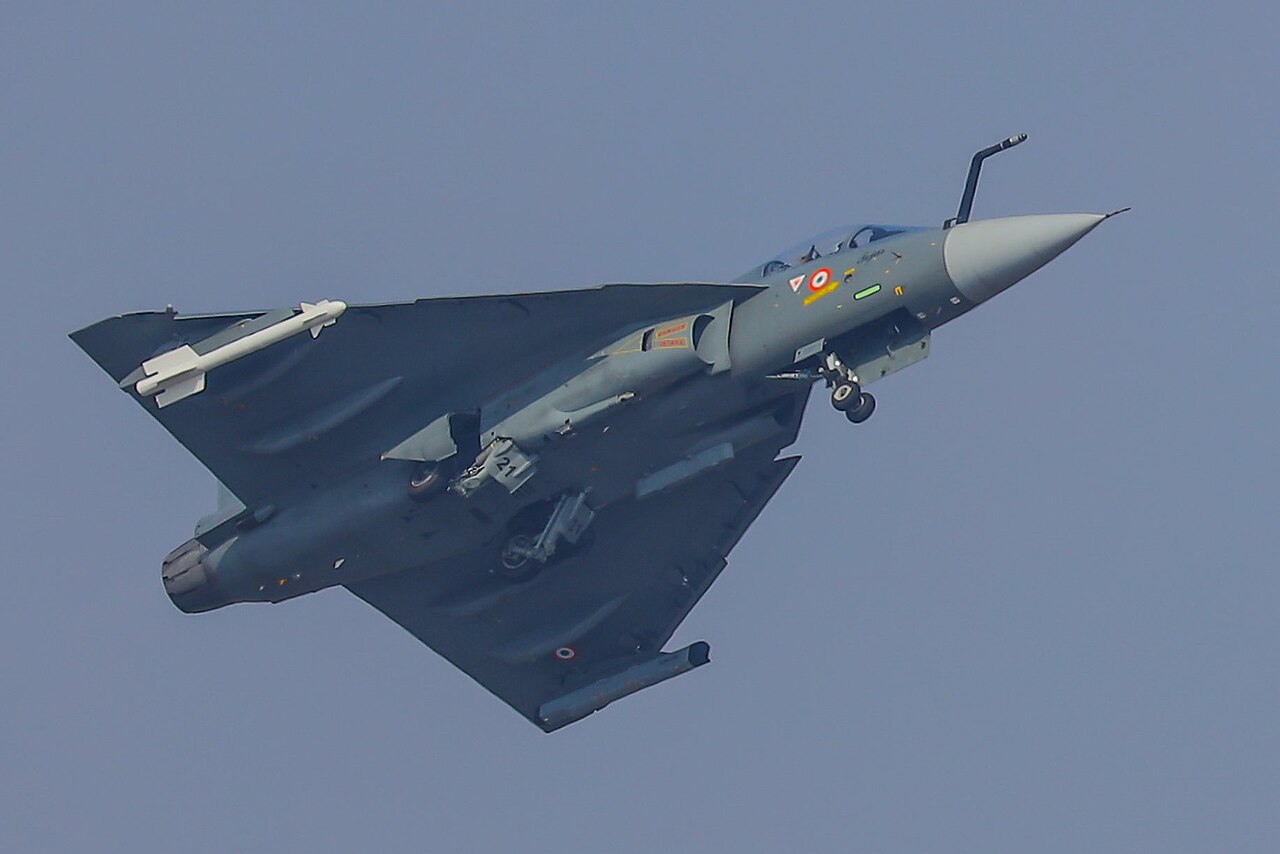
Overview
The Tejas Mk1A is an advanced variant of India’s indigenous Light Combat Aircraft (LCA) Tejas, developed by Hindustan Aeronautics Limited (HAL) for the Indian Air Force (IAF). Building upon the successful Mk1 baseline, the Mk1A introduces a suite of modern avionics, enhanced electronic warfare systems, and expanded weapons compatibility, representing a significant leap in India’s self-reliance in fighter aircraft technology. It is designed to meet the IAF’s evolving operational requirements for a versatile, cost-effective multirole platform capable of both air superiority and strike missions.
Development of the Tejas Mk1A focuses on improved survivability, maintainability, and combat effectiveness. The aircraft incorporates an advanced Active Electronically Scanned Array (AESA) radar, indigenous electronic warfare suite, and the ability to carry a wide range of armaments including both Indian and foreign-origin weapons. Notably, the Mk1A is the first Indian fighter aircraft with mid-air refueling capability, greatly extending its operational range and mission endurance. This aircraft plays a crucial role in modernizing the IAF fleet while significantly reducing dependence on foreign imports and enhancing India’s aerospace manufacturing ecosystem.
With a strong emphasis on modular avionics and maintainability, the Tejas Mk1A is designed to minimize lifecycle costs and maximize operational availability. Its indigenous design and development contribute to the “Make in India” initiative, bolstering India’s strategic aerospace capabilities and defense industrial base.
Specifications
| Parameter | Details |
|---|---|
| Role | Multirole Light Combat Aircraft |
| Manufacturer | Hindustan Aeronautics Limited (HAL) |
| Crew | 1 (Single-seat) |
| Length | 13.2 meters |
| Wingspan | 8.2 meters |
| Height | 4.4 meters |
| Wing Area | 38.0 m² |
| Empty Weight | ~6,500 kg |
| Maximum Takeoff Weight | ~13,500 kg |
| Powerplant | 1 × General Electric F404-GE-IN20 turbofan |
| Thrust | 84 kN (18,000 lbf) with afterburner |
| Maximum Speed | Mach 1.8+ (Approx. 1,900 km/h at altitude) |
| Service Ceiling | 16,500 meters |
| Range | 1,850 km (combat radius with drop tanks) |
| Combat Radius | ~500-600 km (typical strike mission) |
| Avionics | Uttam AESA Radar, Digital Flight Control System, Advanced EW suite |
| Armament | 1 × 23 mm twin-barrel GSh-23 cannon, 6 hardpoints for missiles, bombs, pods |
| Weapons Compatibility | Beyond Visual Range (BVR) missiles, precision-guided munitions, laser-guided bombs, anti-ship missiles, indigenous Astra missile, BrahMos-NG (future) |
| Mid-air Refueling | Probe-and-drogue system |
| Radar Cross Section | Low (Exact figures classified) |
| Avionics Architecture | Modular open systems architecture (MOSA) |
| Electronic Warfare | Indigenous EW suite with radar warning receiver, jammers, chaff/flare dispensers |
| Flight Control System | Digital quadruplex fly-by-wire |
Key Features
🚀 Advanced AESA Radar and Sensor Suite
- Equipped with the indigenous Uttam AESA radar, providing superior target detection, tracking, and multi-target engagement capabilities.
- Enhanced situational awareness with integrated electronic warfare and self-protection sensors.
🎯 Multirole Weapons Integration
- Compatible with a wide range of indigenous and foreign weapons, including Astra BVR missiles, laser-guided bombs, and air-to-air/air-to-ground missiles.
- Designed to carry precision-guided munitions, enabling effective strike missions against diverse targets.
🛡️ Enhanced Survivability and Maintainability
- Indigenous electronic warfare suite for active and passive self-defense.
- Modular avionics architecture allows for easier upgrades and streamlined maintenance, reducing aircraft downtime.
- First Indian fighter with mid-air refueling capability, extending mission endurance and operational flexibility.
Variants
| Variant | Description |
|---|---|
| Tejas Mk1 | Initial production version with basic avionics and weapons integration. |
| Tejas Mk1A | Upgraded Mk1 with AESA radar, mid-air refueling, enhanced EW suite, and modular avionics. Current production standard for IAF. |
| Tejas Mk2 | Next-generation medium-weight fighter with more powerful engine and larger airframe (under development). |
Operational Status
- The Tejas Mk1A entered production in 2021, with the Indian Air Force placing an initial order for 83 aircraft.
- The first Mk1A prototypes conducted maiden flights in 2022, with initial operational clearance (IOC) expected by 2024-2025.
- Currently undergoing operational evaluation with frontline IAF squadrons and progressively inducted to replace aging MiG-21 and MiG-27 fleets.
- The Mk1A is deployed across various bases in India, actively participating in training and exercises to validate its multirole capabilities.
Development Timeline
| Year | Milestone |
|---|---|
| 1983 | LCA program initiated by ADA (Aeronautical Development Agency) |
| 2001 | First flight of Tejas prototype Mk1 |
| 2016 | Tejas Mk1 inducted into IAF |
| 2018 | Tejas Mk1A development approved with focus on indigenous upgrades |
| 2021 | Production of Tejas Mk1A begins |
| 2022 | First Tejas Mk1A prototype flight |
| 2024-25 | Expected Initial Operational Clearance (IOC) for Mk1A |
| 2026+ | Full operational induction and squadron formation |
Strategic Significance
- Indigenous Capability: Tejas Mk1A is central to India’s ambition to achieve self-reliance in advanced combat aircraft technology, reducing dependence on foreign suppliers and embargo risks.
- Fleet Modernization: It replaces legacy fighters like the MiG-21 and MiG-27, bringing modern avionics, improved survivability, and multirole versatility to the IAF.
- Cost Efficiency: Designed with maintainability and modular upgrades in mind, the Mk1A offers a cost-effective solution for sustaining air dominance in the region.
- Enhanced Deterrence: With advanced weapons integration and mid-air refueling, the Mk1A extends India’s strategic reach and quick response capability.
- Export Potential: The Mk1A’s indigenous technology and competitive performance position it as a candidate for defense exports under India’s “Make in India” defense export policy.
Future Upgrades
- Integration of the BrahMos-NG (Next Generation) air-launched cruise missile for precision strike capability.
- Further software upgrades to the AESA radar and electronic warfare systems to enhance multi-target engagement and survivability.
- Potential engine upgrade to a more powerful variant or indigenous powerplant to improve thrust-to-weight ratio.
- Development of two-seat trainer and naval variants to expand operational roles.
- Incorporation of artificial intelligence (AI)-based decision support systems for pilot assistance.
Comparison Table
| Feature | Tejas Mk1 | Tejas Mk1A | Su-30MKI |
|---|---|---|---|
| Radar | Passive Electronically Scanned Array (PESA) | Uttam AESA Radar | N011M Bars PESA Radar |
| Mid-air Refueling | No | Yes | Yes |
| Engine Thrust | 84 kN (GE F404) | 84 kN (GE F404-GE-IN20) | 2 × 125 kN (AL-31FP) |
| Max Speed | Mach 1.6 | Mach 1.8+ | Mach 2.0+ |
| Weapons Compatibility | Limited indigenous | Wide range including Astra and LGBs | Extensive Russian & Indian weapons |
| Avionics Architecture | Conventional | Modular Open Systems | Advanced Integrated Suite |
| Indigenous Content | Moderate | High | Low |
Key Takeaways
- ✅ Indigenous design and production critical for India’s aerospace sovereignty.
- 🎯 Advanced AESA radar and EW suite enhance combat effectiveness.
- 💪 Mid-air refueling capability extends operational range and flexibility.
- 🔧 Modular avionics reduce maintenance time and lifecycle cost.
- 🚀 Multirole capability supports air-to-air, air-to-ground, and precision strike missions.
- 🌐 Plays a pivotal role in modernizing the Indian Air Force and reducing foreign dependency.
Last updated: February 2026
Status: In production and induction phase
Deployed with Indian Air Force frontline squadrons
Sources:
- Hindustan Aeronautics Limited official publications
- Aeronautical Development Agency (ADA) press releases
- Jane’s Defence Weekly
- Indian Ministry of Defence statements
- Flight Global Aerospace Reports