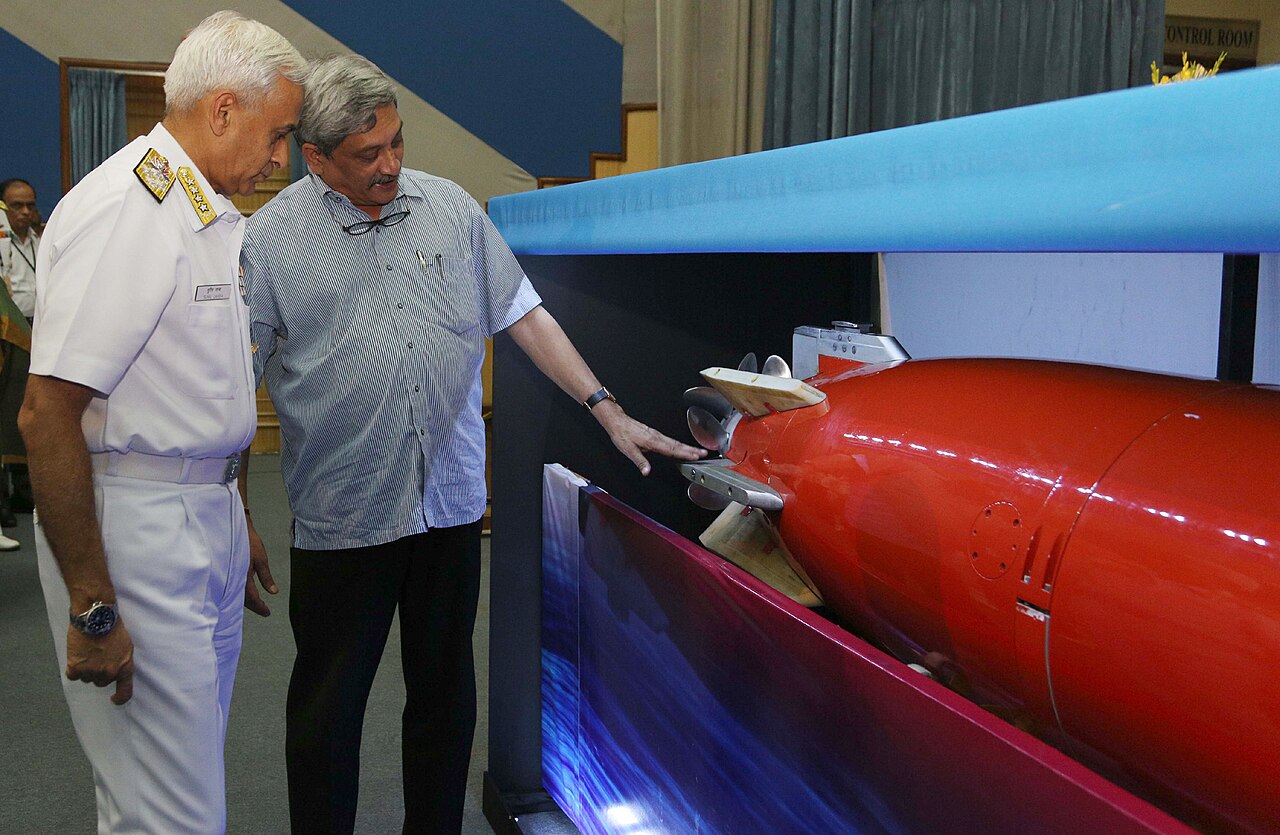
Overview
The Varunastra is a state-of-the-art heavyweight torpedo developed indigenously by India’s Defence Research and Development Organisation (DRDO) in collaboration with the Indian Navy. As the first indigenous heavyweight anti-submarine torpedo, Varunastra represents a significant leap forward in India’s underwater warfare capabilities, reinforcing its maritime security posture and reducing reliance on foreign suppliers. Designed primarily for anti-submarine warfare (ASW), it is capable of engaging and neutralizing hostile submarines and underwater vessels with high precision.
This torpedo is wire-guided and equipped with both active and passive acoustic homing systems, enabling it to track and target enemy submarines in complex underwater environments. With a range exceeding 40 km and a high speed surpassing 40 knots, Varunastra ensures quick and effective response against underwater threats. Its robust design and advanced guidance systems make it a formidable deterrent, boosting the Indian Navy’s offensive and defensive underwater capabilities.
The development of Varunastra marks a key milestone in India’s “Make in India” initiative, showcasing the country’s growing expertise in sophisticated naval weapon systems. It is compatible with multiple naval platforms—surface ships, submarines, and potentially aircraft—making it a versatile asset for multi-dimensional maritime warfare.
Specifications
| Parameter | Specification |
|---|---|
| Type | Heavyweight Anti-Submarine Torpedo |
| Length | ~6 meters (approximate) |
| Diameter | 533 mm (standard torpedo tube size) |
| Weight | ~1,500 kg (approximate) |
| Range | ≥ 40 km |
| Speed | > 40 knots (≈ 74 km/h) |
| Guidance System | Wire-guided with active/passive acoustic homing |
| Warhead | High Explosive (HE); ~250 kg |
| Propulsion | Electric propulsion system |
| Operating Depth | Classified; capable of deep-sea operations |
| Launch Platforms | Surface ships, submarines |
| Manufacturer | Defence Research and Development Organisation (DRDO), India |
| Operational Status | In active service with Indian Navy |
| Development Partners | DRDO, Indian Navy |
Key Features
🚀 Advanced Guidance and Targeting
- Wire-guided control allows real-time course correction during the torpedo’s run, enhancing accuracy against evasive targets.
- Dual active/passive acoustic homing ensures effective target acquisition and tracking in noisy underwater environments.
🎯 Lethal Warhead and Range
- Equipped with a powerful high-explosive warhead capable of disabling or destroying enemy submarines.
- Extended operational range of over 40 km allows engagement of targets well beyond the detection perimeter of the launching platform.
🛡️ Indigenous Design and Versatility
- Fully developed in India by DRDO, aligned with the Make in India initiative, reducing dependence on imports.
- Compatible with multiple launching platforms including surface combatants and submarines, ensuring versatile deployment options.
Variants
As of now, the Varunastra torpedo is deployed primarily in its base heavyweight anti-submarine configuration. Future variants under consideration include:
- Varunastra Mod 1: Enhanced version with improved propulsion for greater speed and extended range.
- Varunastra Mod 2: Integration of advanced AI-assisted guidance systems for autonomous target engagement.
- Lightweight Variant: Under development for deployment from smaller vessels and aircraft (conceptual stage).
Operational Status
The Varunastra torpedo was successfully inducted into the Indian Navy in 2016 after rigorous sea trials and testing phases conducted over several years. It is currently deployed on frontline Indian Navy platforms, including the Kolkata-class destroyers and the Scorpène-class submarines. The weapon system has been operationally tested in varied maritime environments, demonstrating reliability and effectiveness against simulated submarine targets.
The Indian Navy continues to integrate Varunastra into its ASW doctrine, enhancing its ability to secure India’s vast exclusive economic zone (EEZ) and strategic sea lanes against hostile underwater threats.
Development Timeline
| Year | Milestone |
|---|---|
| 2000 | Project conceptualization initiated by DRDO |
| 2005 | Design and development phase commenced |
| 2011 | First prototype testing and trial launches |
| 2014 | Successful completion of sea trials |
| 2016 | Official induction into Indian Navy service |
| 2018 | Integration with Kolkata-class destroyers |
| 2022 | Ongoing upgrades and enhanced guidance system testing |
Strategic Significance
Varunastra represents a strategic asset that strengthens India’s underwater warfare capabilities, critical in an era of increasing maritime competition in the Indian Ocean Region (IOR). As submarine threats from regional and extra-regional actors grow, having an indigenous heavyweight torpedo ensures that India can effectively deter and neutralize such threats without external dependencies. This bolsters India’s sovereignty, maritime domain awareness, and power projection capabilities.
The torpedo also contributes to India’s broader naval modernization efforts and aligns with its ambitions of becoming a net security provider in the IOR. By indigenously developing such advanced weaponry, India enhances its defense industrial base, promotes technological self-reliance, and reduces arms import bills.
Future Upgrades
- Enhanced Propulsion: Plans to integrate next-generation battery technologies and electric propulsion units to increase range and speed.
- AI and Machine Learning: Incorporation of artificial intelligence for improved target discrimination and autonomous operation in complex underwater scenarios.
- Network-Centric Warfare: Integration with naval combat management systems for real-time data sharing and coordinated multi-platform engagements.
- Lightweight Variants: Development of lighter versions for deployment from naval aircraft and smaller vessels to extend operational flexibility.
Comparison Table
| Feature | Varunastra (India) | Mk 48 ADCAP (USA) | Spearfish (UK) |
|---|---|---|---|
| Type | Heavyweight ASW Torpedo | Heavyweight ASW Torpedo | Heavyweight ASW Torpedo |
| Length | ~6 m | 5.8 m | 7.3 m |
| Diameter | 533 mm | 533 mm | 533 mm |
| Range | ≥ 40 km | ~50 km | ~54 km |
| Speed | > 40 knots | > 55 knots | > 70 knots |
| Guidance | Wire-guided + acoustic homing | Wire-guided + acoustic homing | Wire-guided + acoustic homing |
| Warhead | ~250 kg HE | ~292 kg HE | ~300 kg HE |
| Propulsion | Electric | Electric | Electric |
| Indigenous | Yes | No | No |
Key Takeaways
- ✅ India’s first indigenous heavyweight torpedo, a milestone in naval weaponry development.
- 🎯 Equipped with sophisticated wire-guided and dual-mode acoustic homing for precision targeting.
- 💪 Enhances anti-submarine warfare capabilities critical for securing maritime borders.
- 🚀 Boasts a 40+ km range and speeds exceeding 40 knots, enabling rapid threat neutralization.
- 🛡️ Aligns with Make in India initiative, reducing dependence on foreign suppliers.
- 🔄 Compatible with multiple platforms, ensuring versatile deployment in naval operations.
Footer
Last updated: February 14, 2026 | Operational Status: Active service with Indian Navy | Deployment: Kolkata-class destroyers, Scorpène-class submarines
Sources & References:
- Defence Research and Development Organisation (DRDO), India
- Indian Navy official releases and publications
- Jane’s Defence Weekly
- The Economic Times (Defence Section)
- Naval Technology database